



















 ● 20 min read
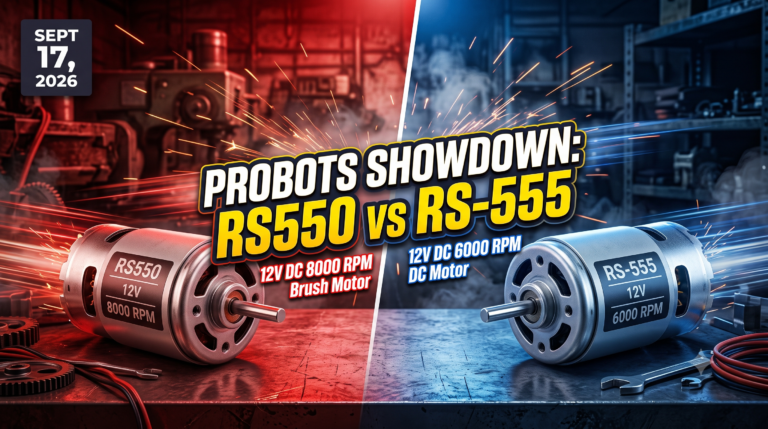
Showdown: RS550 12V DC 8000 vs RS-555 12V DC 6000 RPM DC Motor
Vol. 56 | The Heavyweight DC Drivetrain Duel Reliability isn’t optional when you’re designing actuators that need to move actual steel or
Read Article →
| Bulk Pricing | ||
|---|---|---|
| QTY | Unit Price(Inlc. GST) | |
| 10+ | ₹841.82 ₹ 713.41 + 128.41 GST | |
| 20+ | ₹833.23 ₹ 706.13 + 127.1 GST | |
| 30+ | ₹824.64 ₹ 698.85 + 125.79 GST | |
| 50+ | ₹807.46 ₹ 684.29 + 123.17 GST | |
Accurately measure distances with the VL53L1X Time-of-Flight sensor. Featuring an I2C interface, 2.8V to 5V compatibility, and precise laser-ranging technology within a compact 25x13.3mm footprint.
Precision Time-of-Flight Ranging The VL53L1X is a state-of-the-art, Time-of-Flight (ToF) laser-ranging sensor. Unlike conventional infrared (IR) sensors that estimate distance based on signal intensity (which can be heavily skewed by the color and reflectiveness of the target), this module measures the exact flight time of the invisible laser pulse. This ensures highly accurate, millimeter-level distance measurements.
Compact Form Factor Designed for easy integration into tight spaces, the main body of the PCB measures just 16mm in length and 13.3mm in width. Including the two structural mounting tabs on the sides, the total length of the module is a highly manageable 25mm.
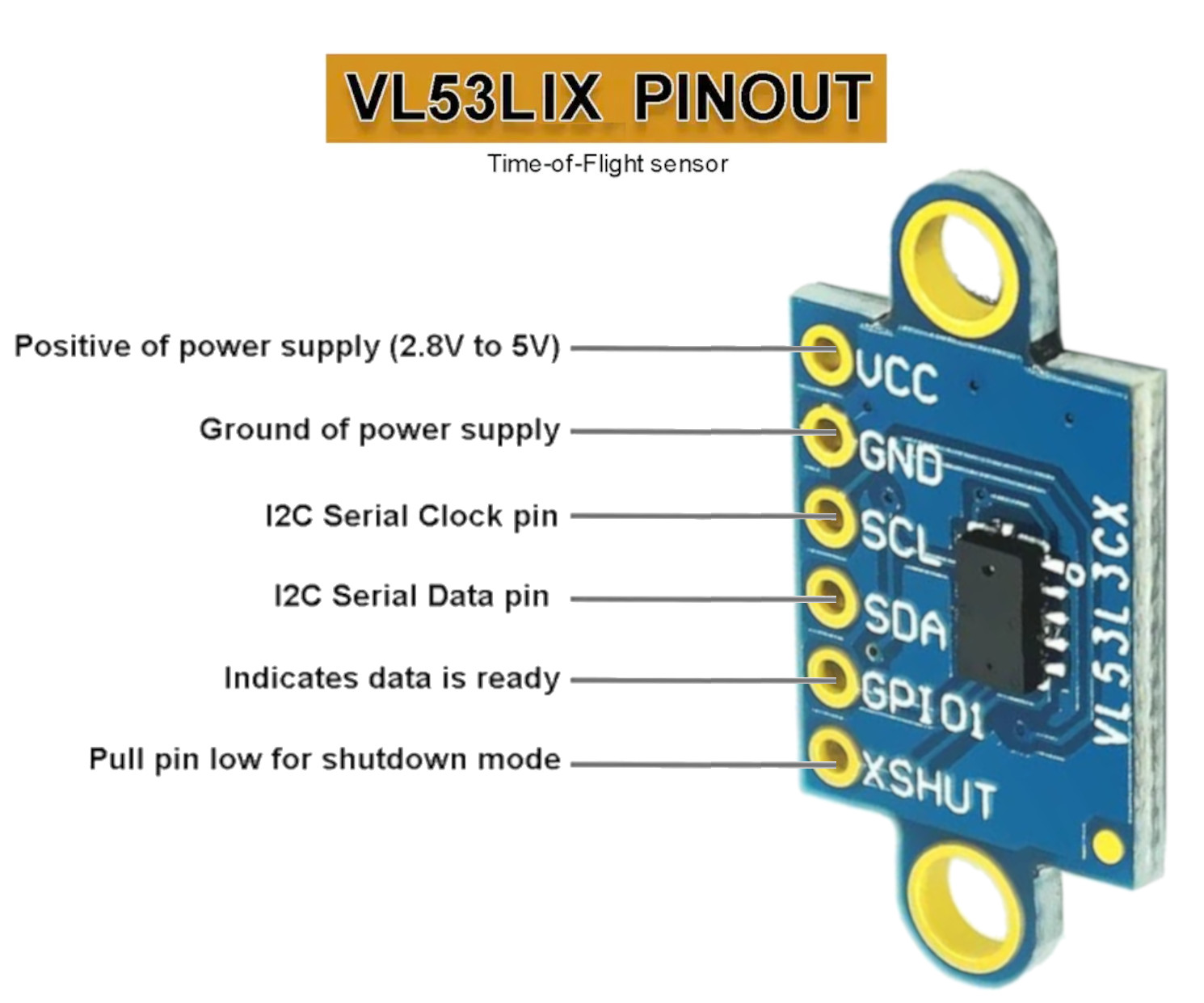
Simple I2C Integration & Control Pins Communicating with this module is extremely straightforward, requiring only two data wires. It utilizes a standard I2C interface, cleanly broken out on the PCB via the SCL (Serial Clock) and SDA (Serial Data) pins. Beyond the standard I2C lines, the board breaks out additional control pins for advanced integration. The GPIO1 pin serves as a programmable interrupt that indicates when new distance data is ready. Additionally, the XSHUT pin acts as a hardware enable/disable switch; pulling this pin low puts the sensor into a deep shutdown mode.
Flexible Power Requirements Designed to be compatible with a wide range of microcontrollers, the module features an onboard voltage regulation and logic-shifting circuit located on the back of the PCB. The VIN / VCC pin accepts a flexible input voltage ranging from 2.8V to 5V.
Please note: To streamline manufacturing, the factory utilises a shared PCB layout. The silkscreen printed on the front of this board reads "VL53L3CX", but the actual core sensor mounted on this specific module is guaranteed to be the VL53L1X.
Specifications
Sensor IC: VL53L1X
Technology: Time-of-Flight (ToF) Laser Ranging
Operating Voltage (VIN/VCC): 2.8V to 5V
Communication Interface: I2C (SCL, SDA)
Control Pins: XSHUT (Hardware Shutdown), GPIO1 (Data Ready Interrupt)
Pin Count: 6 Pins
Dimensions: 25mm Total Length (16mm body) x 13.3mm Width
Key Applications and Projects
Obstacle Avoidance Robotics: Mounting the sensor on the front of a small rover to accurately detect walls and drop-offs, allowing the robot to map its environment and avoid collisions.
Drone Altitude Hold: Pointing the sensor directly downwards on a custom quadcopter to provide highly precise, millimetre-level ground-tracking for stable hovering indoors.
Touchless Smart Home Switches: Embedding the sensor into a wall panel to create a "Jedi" light switch that turns your room lights on or off when you wave your hand within a specific distance.
Unlock New Capabilities (Project Evolution): The Multi-Zone LiDAR Array: Don't stop at just one sensor! Because the VL53L1X features the XSHUT hardware pin, you can wire multiple of these modules to the same I2C bus on an ESP32. By turning them on one by one in your setup() code and dynamically changing their I2C addresses, you can build a 180-degree LiDAR-style array. Mount 5 of these sensors in an arc on your robot, and suddenly your microcontroller can "see" a sweeping 2D map of the room, enabling advanced pathfinding and maze-solving algorithms!
1 x VL53L1X Laser Ranging Sensor Module
1 x 6-Pin Male Header (Unsoldered)
1. What is the main sensor on this module? The active sensing component is the VL53L1X Time-of-Flight laser-ranging sensor.
2. Why does the board say VL53L3CX? Manufacturers often share identical PCB layouts for different sensor generations to save costs. While the silkscreen reads "VL53L3CX", the chip installed on this specific module is the VL53L1X.
3. What communication protocol does it use? The module communicates with your host microcontroller using the I2C protocol via the SCL and SDA pins.
4. What is the operating voltage? The board features an onboard regulator, allowing the VIN (or VCC) pin to safely accept a positive power supply ranging from 2.8V to 5V.
5. Can I use this directly with a 5V Arduino Uno? Yes, because the power input supports up to 5V, you can power it directly from a 5V Arduino without needing an external voltage step-down module.
6. What does the XSHUT pin do? The XSHUT pin is a hardware standby pin. Pulling this pin low forces the sensor into shutdown mode, which is highly useful for saving battery life in portable projects.
7. What does the GPIO1 pin do? The GPIO1 pin acts as an interrupt. It outputs a signal that indicates to your microcontroller that new distance data is ready to be processed.
8. Are the header pins pre-soldered? No, the module comes with a 6-pin male header strip that is loose/unsoldered, allowing you to choose whether to solder the pins for a breadboard or solder wires directly to the pads.
9. What does "Time-of-Flight" mean? Time-of-Flight (ToF) means the sensor emits a tiny, invisible laser pulse and measures the exact time it takes for the light to bounce off an object and return to the sensor.
10. Is the sensor affected by the color of the target object? Unlike traditional IR proximity sensors, ToF sensors are largely immune to target color and surface reflectance, providing consistent measurements regardless of whether the object is white or black.
11. What is the yellow film on the sensor? Some modules arrive with a protective yellow Kapton tape applied at the factory to protect the delicate optical lens during shipping. It must be removed before you attempt to use the sensor.
12. What are the surface mount components on the back? The back of the PCB houses essential support circuitry, including a voltage regulator, I2C pull-up resistors, and decoupling capacitors to ensure stable operation.
13. How many pins does the module have? The module breaks out a total of six pins: VIN (or VCC), GND, SCL, SDA, GPIO1, and XSHUT.
14. What are the two large holes on the edges for? These are structural mounting holes, allowing you to securely screw the sensor module onto a robot chassis or an enclosure.
15. What are the exact dimensions of this board? The PCB is 13.3mm wide. The main rectangular body is 16mm long, and the total length from ear to ear is 25mm.
16. What is the default I2C address of the sensor? The default I2C address for the VL53L1X is typically 0x29.
17. Can I use multiple of these sensors on the same I2C bus? Yes, but because they all share the same default address, you must wire the XSHUT pin of each sensor to a different GPIO on your microcontroller to toggle them on individually and reassign their addresses via software.
18. Does this module have a microcontroller on it? No, this is purely a sensor breakout board. It cannot execute code on its own and requires a "brain" like an ESP32 or Arduino.
19. What libraries can I use to program this? Popular, well-documented libraries for Arduino include the SparkFun VL53L1X library and the Pololu VL53L1X library.
20. What does the "GND" pin connect to? The GND pin is the ground of the power supply and must be connected to the ground of your microcontroller to complete the electrical circuit.

| Sensor Technology | LiDAR / ToF (Time of Flight) |
|---|---|
| Scanning Type | Single-Point (1D) |
| Max Measurement Range | Medium Range (1m to 5m) |
| Output Interface | Digital (I2C) |
| Operating Environment | Indoor Use |
| Manufacturer | Generic |
Probots sells every Electronics Part for your next Project. You can order 10,000+ Electronic Parts Online - Arduino, Raspberry Pi, NodeMCU Development Boards, Sensors, Motors, Motor Drivers, SMPS, Plastic Enclosures etc in India directly on probots.co.in
We delivery electronics components and parts throughout India using standard couriers like Bluedart, Delhivery & India Post.
For order related queries contact -
This item is covered by a warranty of 7 days from the date of delivery, against confirmed manufacturing defects only, as verified by Probots' own testing and investigation. In case of a confirmed defect, we will replace the item — a refund is issued only if a replacement can't be supplied (e.g. discontinued or out of stock). Transit damage or a wrong item received must be reported within 3 days of delivery.
If the product shows signs of misuse, tampering, physical damage, static discharge, liquid or fire damage, use of unapproved chemicals, or has been soldered or physically altered in any way.
China
Probots sells every Electronics Part for your next Project. You can order 10,000+ Electronic Parts Online - Arduino, Raspberry Pi, NodeMCU Development Boards, Sensors, Motors, Motor Drivers, SMPS, Plastic Enclosures etc in India directly on probots.co.in
We offer specialized services for Bulk, Wholesale & B2B Customers like discounted prices, additional shipping options, customised products, etc . Customer with large quantity & regular orders qualify for the specialised discounted rates.
We also offer dedicated sales team to assist you with the order process by providing sales quotations, PI, technical support for choosing products, etc.
Note: Business Orders are processed manually and usually take 1-3 days to process compared to placing the order directly on our website. Please plan your purchases accordingly.
Need Help?
For bulk enquiries contact us by -


Probots Electronics is highly regarded for its highly skilled team and knowledgeable staff who provide expert guidance to ensure customers select the right components for their technical projects. The business maintains a strong reputation for prompt service and reliable support, with many clients praising their quick response times and genuine commitment to customer satisfaction.


A very great place for electronics Such a well maintained shop... Felt good shopping here


Nice

For new developments kit available and they will support till working, and I suggest this place strongly


This place has all the electronic parts students will ever need, staff is friendly and the place is organised.


It was a really nice experience! I was happy to find such a wide range of robotics kits for kids, suitable for different age groups and learning levels.

Excellent experience




Good stuff

Buyed them. But no bargain. Helpful staff.


Available all children school project spears parts like electronics


It was good experience




Staff is very patient and helpful

One of the best place for electronics you will get everything you want! With the best and orginal quality

Very helpful staff and the best place to buy components for projects

Wonderful store with expert service and technically strong people.

Prompt delivery, excellent technical support


Large inventory of electronic components and parts. Well trained service personnel and technicians who can quickly identify and rectify product defect if any. They are a reliable and trustworthy online stores.

A very great place for electronics Such a well maintained shop... Felt good shopping here
Nice
For new developments kit available and they will support till working, and I suggest this place strongly
This place has all the electronic parts students will ever need, staff is friendly and the place is organised.
It was a really nice experience! I was happy to find such a wide range of robotics kits for kids, suitable for different age groups and learning levels.
Excellent experience
Good stuff
Buyed them. But no bargain. Helpful staff.
Available all children school project spears parts like electronics
It was good experience
Staff is very patient and helpful
One of the best place for electronics you will get everything you want! With the best and orginal quality
Very helpful staff and the best place to buy components for projects
Wonderful store with expert service and technically strong people.
Prompt delivery, excellent technical support
Large inventory of electronic components and parts. Well trained service personnel and technicians who can quickly identify and rectify product defect if any. They are a reliable and trustworthy online stores.
● 20 min readVol. 56 | The Heavyweight DC Drivetrain Duel Reliability isn’t optional when you’re designing actuators that need to move actual steel or
Read Article → ● 13 min read
Workbench Vol. 49 🚀 The Project Trifecta: 3 Builds to Start Today We don’t just stock parts; we curate ecosystems. This week’s arrivals are desi
Read Article → ● 18 min read
Vol. 59 | The Battle of the Bite-Sized Boards Picture a project that needs full Linux, networking, and GPIO—but has almost no room for a conventional
Read Article →