



















 ● 20 min read
Showdown: RS550 12V DC 8000 vs RS-555 12V DC 6000 RPM DC Motor
Vol. 56 | The Heavyweight DC Drivetrain Duel Reliability isn’t optional when you’re designing actuators that need to move actual steel or
Read Article →
| Bulk Pricing | ||
|---|---|---|
| QTY | Unit Price(Inlc. GST) | |
| 25+ | ₹38.22 ₹ 32.39 + 5.83 GST | |
| 50+ | ₹37.83 ₹ 32.06 + 5.77 GST | |
| 75+ | ₹37.44 ₹ 31.73 + 5.71 GST | |
| 100+ | ₹36.66 ₹ 31.07 + 5.59 GST | |
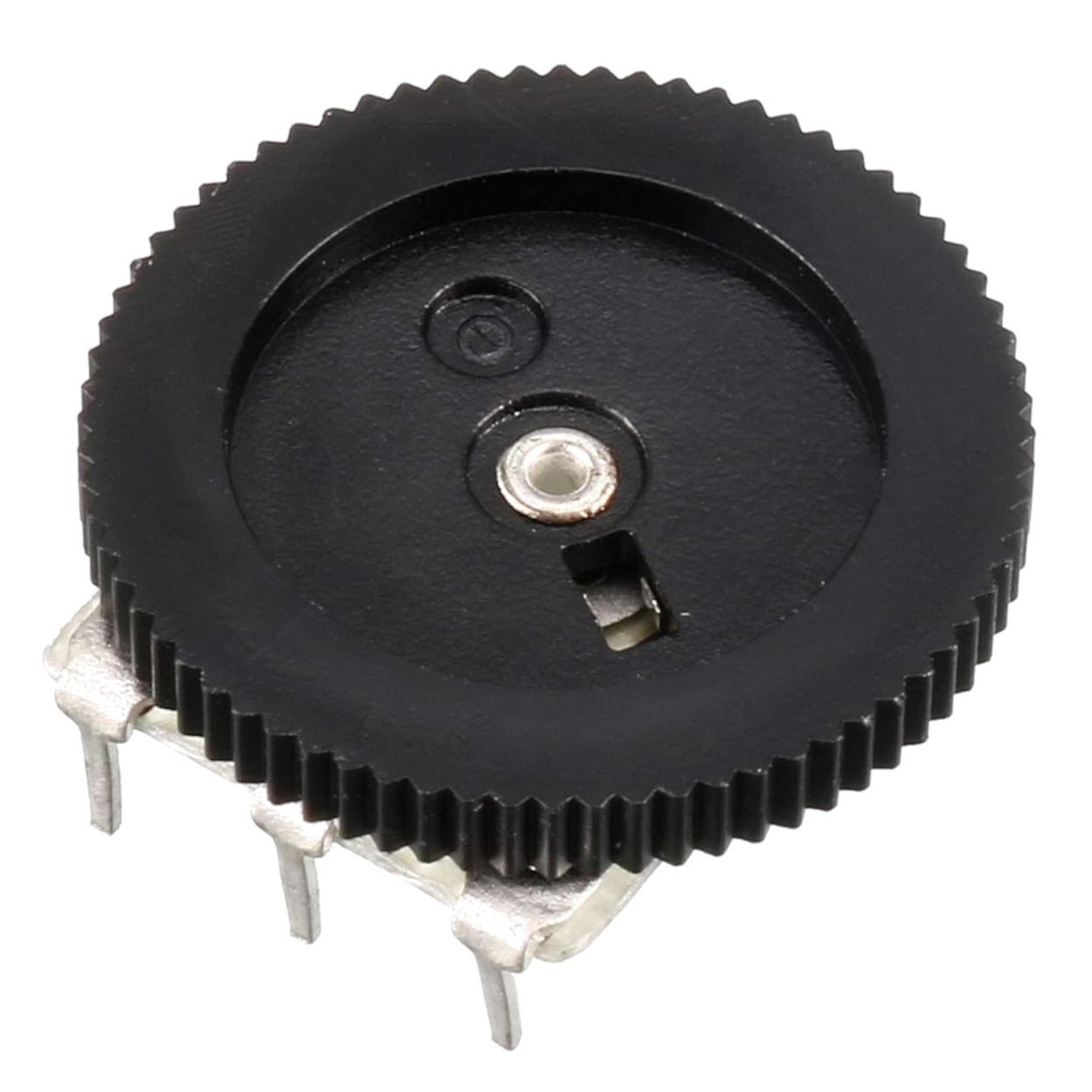
Control volume or analog inputs easily! This compact B103 potentiometer features a 10kΩ resistance, a 16.0mm ridged black thumbwheel, and a standard 3-pin layout.
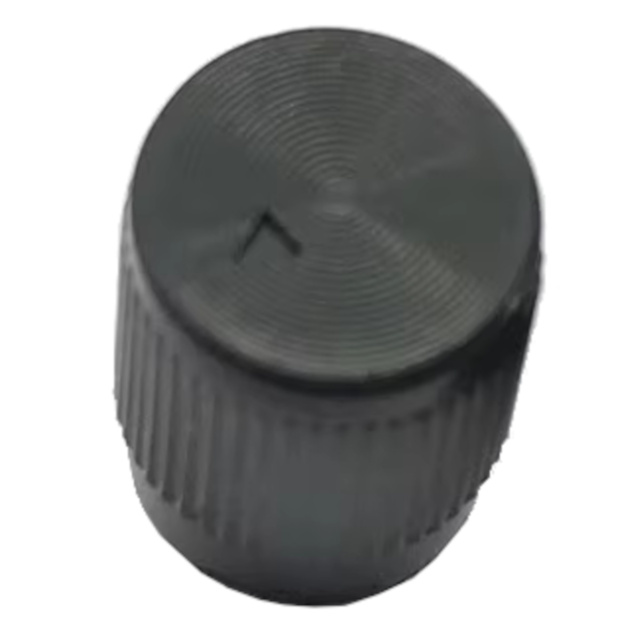
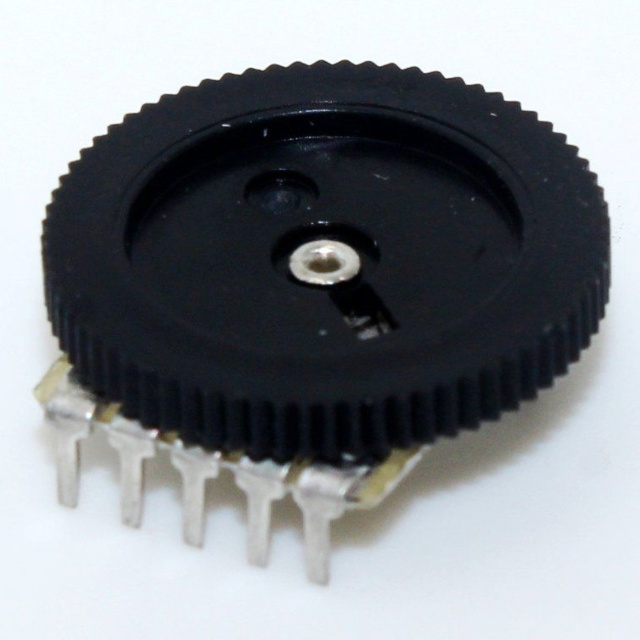
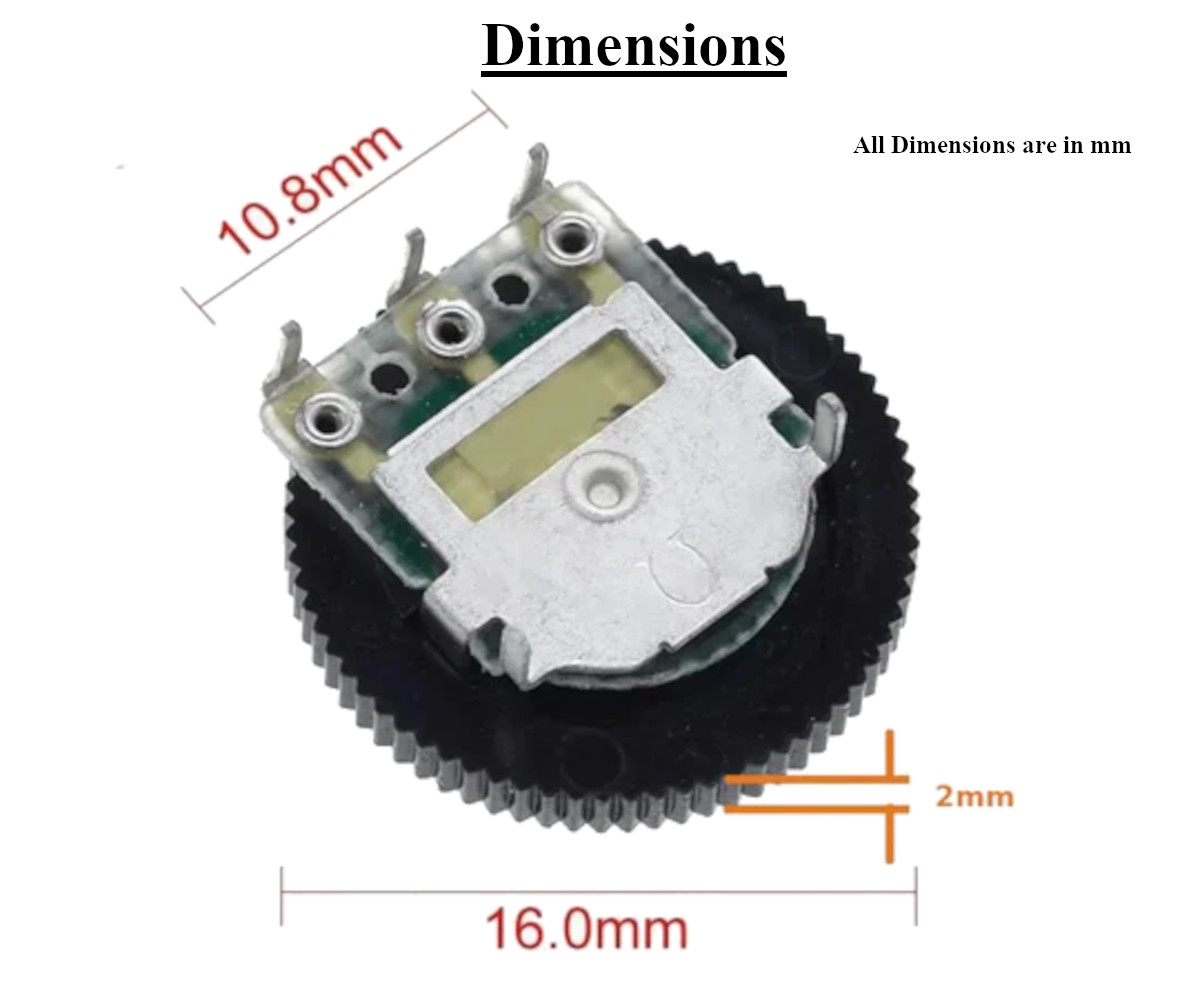
Compact Analog Control The B103 dial potentiometer is a highly compact variable resistor ideal for space-constrained applications. With a total thumbwheel diameter of exactly 16.0mm and an edge thickness of just 2mm, it protrudes just enough from an enclosure slot to offer precise, tactile adjustments. The black plastic wheel features a heavily ridged outer edge, providing excellent grip for the user's thumb.
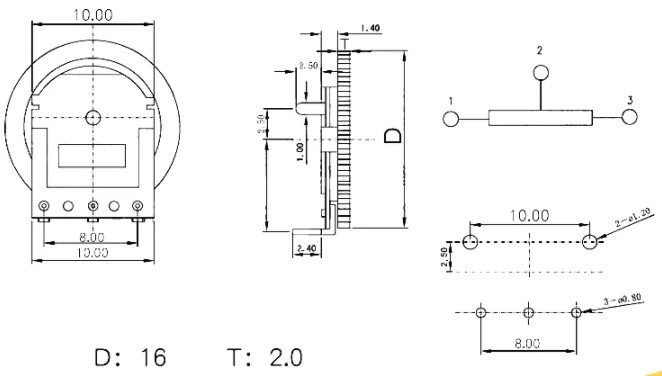
Standard Single-Gang Configuration This potentiometer features a standard 3-pin, single-gang layout. The outer two pins serve as the ends of the fixed 10kΩ resistive track, while the center pin acts as the "wiper" that moves along the track as the wheel is turned. The total width across the pin array is 10.8mm, making it easy to map out in PCB design software. Note that while the internal green PCB has five holes, this specific single-gang model only utilizes three populated pins.
Rugged Housing To ensure mechanical stability, the resistive track and wiper assembly are protected by a sturdy metal shield. This shield is stamped directly with the "B103" model designation. The shield also includes two structural metal tabs folded over the edges of the miniature internal PCB, ensuring the component does not easily break apart under rotational stress when mounted. Additional mounting tabs are provided on the sides to solder the housing directly to your circuit board for enhanced rigidity.
Technical Specifications
Component Type: Dial / Thumbwheel Potentiometer
Resistance Value: 10kΩ (Marked B103)
Taper: Linear (B Type)
Wheel Diameter: 16.0mm
Wheel Edge Thickness: 2mm
Pin Pitch/Width: Total width 10.8mm across 3 pins
Configuration: Single-Gang, 3-Pin
Housing: Metal shield with structural PCB mounting tabs
Key Applications and Projects
Portable Audio Amplifiers: Acting as a compact volume dial for DIY pocket radios or LM386 audio amplifier modules.
Screen Brightness/Contrast: Adjusting the contrast of 16x2 LCD screens or the brightness of LED backlights on custom control panels.
Analog Parameter Tuning: Serving as a miniature variable input dial for microcontrollers to adjust blink rates, servo motor angles, or timer delays.
Unlock New Capabilities (Project Evolution)The Mini MIDI Controller: Don't just use it for volume! Mount three of these 16mm thumbwheel potentiometers side-by-side on a custom PCB wired to an Arduino Pro Micro. Program the Arduino as a USB MIDI device. Now you have a custom, ultra-low-profile mixing board to intuitively control EQ levels, brush sizes in Photoshop, or audio tracks in OBS Studio, taking up less space than a standard keyboard numeric pad!
1 x B103 (10kΩ) 16mm Thumbwheel Dial Potentiometer
1. What is the total resistance of this potentiometer? The resistance is 10k Ohms, which is indicated by the "B103" marking.
2. What does the "B" in B103 stand for? In potentiometer manufacturing codes, "B" typically denotes a linear taper, meaning the resistance changes at a constant rate as the wheel is turned.
3. What is the overall diameter of the thumbwheel? The overall diameter of the black wheel is exactly 16.0mm.
4. How thick is the edge of the thumbwheel? The ridged edge of the thumbwheel has a thickness of 2mm.
5. How many electrical pins does it have? This is a single-gang model and features three active electrical pins.
6. What is the distance across the pin array? The total width across the pin array is 10.8mm.
7. Why are there five holes on the PCB but only three pins? The internal PCB is often shared in manufacturing with dual-gang (stereo) versions of the potentiometer. Because this is a single-gang mono version, only three pins are populated.
8. What material is the thumbwheel made of? The thumbwheel is molded from black plastic.
9. Does the thumbwheel have grip? Yes, the outer edge of the wheel is heavily ridged (knurled) to provide friction for your thumb.
10. What is printed on the metal housing? The part number "B103" is stamped directly onto the face of the metal shield.
11. How is the internal PCB secured to the housing? It is secured via folded metal tabs extending from the main metal shield over the edges of the green PCB.
12. Can this be used as a volume control? Yes, dial potentiometers like this are the industry standard for controlling volume on portable radios and mini amplifiers.
13. Is this a single-turn or multi-turn potentiometer? This is a standard single-turn potentiometer; it features a hard physical stop at the minimum and maximum rotational limits.
14. Can it be mounted on a breadboard? The pins are somewhat short and bent, making it difficult to seat securely in a standard breadboard. It is best suited for direct PCB soldering.
15. How do I wire it as a variable voltage divider? Connect one outer pin to your voltage source (VCC), the other outer pin to Ground (GND), and read the variable voltage from the center wiper pin.
16. Is the thumbwheel removable? No, the black plastic thumbwheel is permanently integrated into the rotating wiper assembly and cannot be removed without destroying the component.
17. Which pin is the wiper? The center pin among the three active electrical pins is the wiper.
18. What do the extra metal legs on the sides do? The outer metal legs extending from the shield are structural mounting tabs designed to be soldered to the PCB to absorb physical stress when the wheel is turned.
19. Can I use this with an Arduino or ESP32? Yes, by wiring it as a voltage divider, you can connect the center pin to an Analog-to-Digital (ADC) pin on your microcontroller to read its position.
20. Is the back of the thumbwheel completely flat? No, the back of the black plastic wheel features a molded circular recess and a central rotation pivot.
| Technical Details |
Probots Round Dial Potentiometer Pinout |
|---|
Probots sells every Electronics Part for your next Project. You can order 10,000+ Electronic Parts Online - Arduino, Raspberry Pi, NodeMCU Development Boards, Sensors, Motors, Motor Drivers, SMPS, Plastic Enclosures etc in India directly on probots.co.in
We delivery electronics components and parts throughout India using standard couriers like Bluedart, Delhivery & India Post.
For order related queries contact -
This item is covered by a warranty of 7 days from the date of delivery, against confirmed manufacturing defects only, as verified by Probots' own testing and investigation. In case of a confirmed defect, we will replace the item — a refund is issued only if a replacement can't be supplied (e.g. discontinued or out of stock). Transit damage or a wrong item received must be reported within 3 days of delivery.
If the product shows signs of misuse, tampering, physical damage, static discharge, liquid or fire damage, use of unapproved chemicals, or has been soldered or physically altered in any way.
China
Probots sells every Electronics Part for your next Project. You can order 10,000+ Electronic Parts Online - Arduino, Raspberry Pi, NodeMCU Development Boards, Sensors, Motors, Motor Drivers, SMPS, Plastic Enclosures etc in India directly on probots.co.in
We offer specialized services for Bulk, Wholesale & B2B Customers like discounted prices, additional shipping options, customised products, etc . Customer with large quantity & regular orders qualify for the specialised discounted rates.
We also offer dedicated sales team to assist you with the order process by providing sales quotations, PI, technical support for choosing products, etc.
Note: Business Orders are processed manually and usually take 1-3 days to process compared to placing the order directly on our website. Please plan your purchases accordingly.
Need Help?
For bulk enquiries contact us by -
Probots Electronics is highly regarded for its highly skilled team and knowledgeable staff who provide expert guidance to ensure customers select the right components for their technical projects. The business maintains a strong reputation for prompt service and reliable support, with many clients praising their quick response times and genuine commitment to customer satisfaction.


A very great place for electronics Such a well maintained shop... Felt good shopping here


Nice

For new developments kit available and they will support till working, and I suggest this place strongly


This place has all the electronic parts students will ever need, staff is friendly and the place is organised.


It was a really nice experience! I was happy to find such a wide range of robotics kits for kids, suitable for different age groups and learning levels.

Excellent experience




Good stuff

Buyed them. But no bargain. Helpful staff.


Available all children school project spears parts like electronics


It was good experience




Staff is very patient and helpful

One of the best place for electronics you will get everything you want! With the best and orginal quality

Very helpful staff and the best place to buy components for projects

Wonderful store with expert service and technically strong people.

Prompt delivery, excellent technical support


Large inventory of electronic components and parts. Well trained service personnel and technicians who can quickly identify and rectify product defect if any. They are a reliable and trustworthy online stores.

A very great place for electronics Such a well maintained shop... Felt good shopping here
Nice
For new developments kit available and they will support till working, and I suggest this place strongly
This place has all the electronic parts students will ever need, staff is friendly and the place is organised.
It was a really nice experience! I was happy to find such a wide range of robotics kits for kids, suitable for different age groups and learning levels.
Excellent experience
Good stuff
Buyed them. But no bargain. Helpful staff.
Available all children school project spears parts like electronics
It was good experience
Staff is very patient and helpful
One of the best place for electronics you will get everything you want! With the best and orginal quality
Very helpful staff and the best place to buy components for projects
Wonderful store with expert service and technically strong people.
Prompt delivery, excellent technical support
Large inventory of electronic components and parts. Well trained service personnel and technicians who can quickly identify and rectify product defect if any. They are a reliable and trustworthy online stores.
● 20 min readVol. 56 | The Heavyweight DC Drivetrain Duel Reliability isn’t optional when you’re designing actuators that need to move actual steel or
Read Article → ● 13 min read
Workbench Vol. 49 🚀 The Project Trifecta: 3 Builds to Start Today We don’t just stock parts; we curate ecosystems. This week’s arrivals are desi
Read Article → ● 18 min read
Vol. 59 | The Battle of the Bite-Sized Boards Picture a project that needs full Linux, networking, and GPIO—but has almost no room for a conventional
Read Article →