














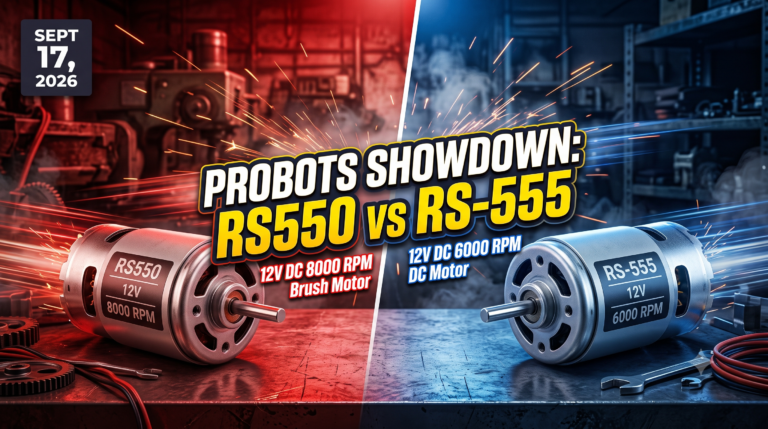
 ● 20 min read
Showdown: RS550 12V DC 8000 vs RS-555 12V DC 6000 RPM DC Motor
Vol. 56 | The Heavyweight DC Drivetrain Duel Reliability isn’t optional when you’re designing actuators that need to move actual steel or
Read Article →
| Bulk Pricing | ||
|---|---|---|
| QTY | Unit Price(Inlc. GST) | |
| 10+ | ₹2,939.02 ₹ 2490.69 + 448.32 GST | |
| 20+ | ₹2,909.03 ₹ 2465.28 + 443.75 GST | |
| 30+ | ₹2,879.04 ₹ 2439.86 + 439.17 GST | |
| 50+ | ₹2,819.06 ₹ 2389.03 + 430.03 GST | |
Pack massive IoT power into your pocket! The LILYGO T-Dongle-S3 features an ESP32-S3 processor, 16MB Flash, a vibrant 0.96-inch IPS LCD, and a TF card slot, all housed in a sleek, transparent USB stick enclosure.
Pocket-Sized ESP32-S3 Power Gone are the days of carrying around bulky breadboards and tangled wires. The T-Dongle-S3 shrinks your development environment down to the size of a standard flash drive. At its core lies the formidable ESP32-S3 dual-core microcontroller, delivering robust 2.4 GHz Wi-Fi and Bluetooth 5 (LE) connectivity. With a massive 16MB of onboard Flash memory, you have virtually unlimited space to store complex firmware, web server files, and graphical UI assets.
Vibrant 0.96-Inch IPS Display Despite its tiny footprint, LILYGO managed to integrate a brilliant 0.96-inch IPS LCD directly into the front face of the dongle. Driven by the highly efficient ST7735 display controller, it outputs a sharp 80 x 160 pixel resolution. Because it uses IPS technology, the screen offers excellent contrast, deep colors, and wide viewing angles, making it perfect for displaying live network statistics, scrolling text, or colorful status icons.
Data Logging and Expansion Built-In The T-Dongle-S3 is a self-contained data powerhouse. Tucked neatly into the side of the board is a TF (MicroSD) card slot. This allows you to log gigabytes of sensor data, network packets, or security logs locally. Furthermore, the board features a tiny STEMMA QT / Qwiic compatible JST-SH 1.0mm 4-pin connector. Uniquely, this port is mapped to the UART TX/RX pins (IO43 and IO44) rather than I2C, allowing for rapid serial expansion and debugging with external GPS modules or serial sensors.
Specifications
Microcontroller: ESP32-S3 (Dual-core, up to 240 MHz)
Flash Memory: 16MB
Wireless: Wi-Fi (802.11 b/g/n) & Bluetooth 5 (LE)
Display Size: 0.96 inches diagonal
Display Driver: ST7735
Resolution: 80 x 160 pixels
Host Interface: Male USB Type-A
Storage: Integrated TF/MicroSD Card Slot
Expansion Port: STEMMA QT / Qwiic JST-SH 1.0mm 4-PIN (Mapped to UART TX/RX)
Enclosure: Transparent protective casing with removable USB cap
Dimensions: 58.6mm (L) x 17.9mm (W) x 8.7mm (H)
Key Applications and Projects
Portable Crypto/Stock Tickers: Plug it into the side of your monitor or a USB wall charger to constantly display live financial charts pulled via Wi-Fi APIs.
Hardware Security Keys: Programming the ESP32-S3 to act as a custom two-factor authentication (2FA) device or password vault.
Miniature Web Servers: Hosting a captive portal or a localized intranet site directly from your pocket for field-testing or presentations.
Unlock New Capabilities (Project Evolution) The Stealth Wi-Fi Network Analyzer: Turn this innocent-looking USB stick into a powerful cybersecurity and network diagnostic tool! Because the ESP32-S3 can easily be put into "promiscuous mode," you can program the T-Dongle-S3 to act as a localized packet sniffer or Wi-Fi scanner. Write a script that scans for surrounding Wi-Fi networks, measures their signal strength (RSSI), and identifies channel crowding. Display the network statistics visually on the 0.96-inch LCD, and log the detailed packet data directly to the onboard MicroSD card. Just plug it into a standard USB power bank, and you have a highly portable, completely self-contained network auditing device!
1 x LILYGO T-Dongle-S3 Board (with 0.96" LCD)
1 x Transparent Protective Casing (Pre-installed)
1 x Removable USB Cap
Downloads & Links

1. What microcontroller drives this board? It is powered by the Espressif ESP32-S3 dual-core microprocessor.
2. How much Flash memory does it have? It features a massive 16MB of onboard Flash memory.
3. What are the specifications of the onboard screen? The screen is a 0.96-inch diagonal IPS LCD. It has a resolution of 80x160 pixels and is driven by the ST7735 display controller.
4. Does the screen have touch capabilities? No, the 0.96-inch LCD is a standard non-touch display.
5. How do I power the T-Dongle-S3? You simply plug it into any standard USB Type-A port, such as a laptop, desktop PC, USB wall charger, or portable power bank.
6. Does it have a battery inside? No. Because of its compact USB stick form factor, there is no internal battery. It relies entirely on external USB power.
7. How do I program this board? You plug it directly into your computer's USB port. It utilizes the ESP32-S3's native USB capabilities (USB_DN IO19, USB_DP IO20) and can be programmed using the Arduino IDE, PlatformIO, or MicroPython.
8. What settings should I use in the Arduino IDE? Select the "ESP32S3 Dev Module". Ensure you set "USB CDC On Boot" to Enabled, and Flash Size to 16MB.
9. Can I log data locally? Yes! The board features a TF (MicroSD) card slot integrated into the side of the PCB.
10. What are the internal pins used for the MicroSD card slot? The SD card uses SDMMC standard pins: D0 (IO14), D1 (IO17), D2 (IO21), D3 (IO18), CLK (IO12), and CMD (IO16).
11. Is there an expansion port for sensors? Yes. It features a STEMMA QT / Qwiic compatible JST-SH 1.0mm 4-PIN connector on the side.
12. Is the expansion port wired for I2C? Note carefully: While it uses a Qwiic-style connector, LILYGO has mapped this specific port to UART (Serial) pins: RX (IO44) and TX (IO43), along with 3.3V and GND.
13. Does it support Wi-Fi and Bluetooth? Yes, it features standard 2.4 GHz Wi-Fi (802.11 b/g/n) and Bluetooth 5.0 (LE) for connecting to your local network or smartphone.
14. What type of antenna does it use? It utilizes an onboard ceramic/chip antenna located near the top of the PCB for a compact, snag-free wireless profile.
15. What is the physical button on the back for? The tactile button located on the rear of the PCB is the "Boot" button, mapped to IO00. It can be used to manually enter flashing mode or programmed as a user input button in your code.
16. What material is the casing made from? The board is enclosed in a durable, transparent acrylic/plastic casing that protects the electronics while allowing you to view the PCB and screen.
17. What are the exact dimensions of the dongle? With the cap on, the dongle measures 58.6mm in length, 17.9mm in width, and 8.7mm in height.
18. Which pins are used internally for the LCD? The ST7735 LCD uses several internal pins: CS (IO04), SDA (IO03), SCL (IO05), DC (IO02), RES (IO01), and the LED backlight is controlled by IO38.
19. What do the LED_DI_PIN (IO40) and LED_CI_PIN (IO39) refer to? These pins are internally routed to support onboard programmable RGB LEDs (like APA102 or WS2812 type LEDs) if present on your specific board revision.
20. What logic voltage does the ESP32-S3 use? Like all ESP32 chips, the internal GPIO pins operate strictly on 3.3V logic. The board regulates the 5V from the USB port down to 3.3V safely.

| Core Chipset: | ESP32-S3 |
|---|---|
| Flash Memory: | 16 MB |
| Wireless Connectivity: | WiFi, Bluetooth |
| Antenna Type: | Onboard Ceramic Chip |
Probots sells every Electronics Part for your next Project. You can order 10,000+ Electronic Parts Online - Arduino, Raspberry Pi, NodeMCU Development Boards, Sensors, Motors, Motor Drivers, SMPS, Plastic Enclosures etc in India directly on probots.co.in
We delivery electronics components and parts throughout India using standard couriers like Bluedart, Delhivery & India Post.
For order related queries contact -
This item is covered by a warranty of 7 days from the date of delivery, against confirmed manufacturing defects only, as verified by Probots' own testing and investigation. In case of a confirmed defect, we will replace the item — a refund is issued only if a replacement can't be supplied (e.g. discontinued or out of stock). Transit damage or a wrong item received must be reported within 3 days of delivery.
If the product shows signs of misuse, tampering, physical damage, static discharge, liquid or fire damage, use of unapproved chemicals, or has been soldered or physically altered in any way.
China
Probots sells every Electronics Part for your next Project. You can order 10,000+ Electronic Parts Online - Arduino, Raspberry Pi, NodeMCU Development Boards, Sensors, Motors, Motor Drivers, SMPS, Plastic Enclosures etc in India directly on probots.co.in
We offer specialized services for Bulk, Wholesale & B2B Customers like discounted prices, additional shipping options, customised products, etc . Customer with large quantity & regular orders qualify for the specialised discounted rates.
We also offer dedicated sales team to assist you with the order process by providing sales quotations, PI, technical support for choosing products, etc.
Note: Business Orders are processed manually and usually take 1-3 days to process compared to placing the order directly on our website. Please plan your purchases accordingly.
Need Help?
For bulk enquiries contact us by -


Probots Electronics is highly regarded for its highly skilled team and knowledgeable staff who provide expert guidance to ensure customers select the right components for their technical projects. The business maintains a strong reputation for prompt service and reliable support, with many clients praising their quick response times and genuine commitment to customer satisfaction.


A very great place for electronics Such a well maintained shop... Felt good shopping here


Nice

For new developments kit available and they will support till working, and I suggest this place strongly


This place has all the electronic parts students will ever need, staff is friendly and the place is organised.


It was a really nice experience! I was happy to find such a wide range of robotics kits for kids, suitable for different age groups and learning levels.

Excellent experience




Good stuff

Buyed them. But no bargain. Helpful staff.


Available all children school project spears parts like electronics


It was good experience




Staff is very patient and helpful

One of the best place for electronics you will get everything you want! With the best and orginal quality

Very helpful staff and the best place to buy components for projects

Wonderful store with expert service and technically strong people.

Prompt delivery, excellent technical support


Large inventory of electronic components and parts. Well trained service personnel and technicians who can quickly identify and rectify product defect if any. They are a reliable and trustworthy online stores.

A very great place for electronics Such a well maintained shop... Felt good shopping here
Nice
For new developments kit available and they will support till working, and I suggest this place strongly
This place has all the electronic parts students will ever need, staff is friendly and the place is organised.
It was a really nice experience! I was happy to find such a wide range of robotics kits for kids, suitable for different age groups and learning levels.
Excellent experience
Good stuff
Buyed them. But no bargain. Helpful staff.
Available all children school project spears parts like electronics
It was good experience
Staff is very patient and helpful
One of the best place for electronics you will get everything you want! With the best and orginal quality
Very helpful staff and the best place to buy components for projects
Wonderful store with expert service and technically strong people.
Prompt delivery, excellent technical support
Large inventory of electronic components and parts. Well trained service personnel and technicians who can quickly identify and rectify product defect if any. They are a reliable and trustworthy online stores.
● 20 min readVol. 56 | The Heavyweight DC Drivetrain Duel Reliability isn’t optional when you’re designing actuators that need to move actual steel or
Read Article → ● 13 min read
Workbench Vol. 49 🚀 The Project Trifecta: 3 Builds to Start Today We don’t just stock parts; we curate ecosystems. This week’s arrivals are desi
Read Article → ● 18 min read
Vol. 59 | The Battle of the Bite-Sized Boards Picture a project that needs full Linux, networking, and GPIO—but has almost no room for a conventional
Read Article →