
















 ● 20 min read
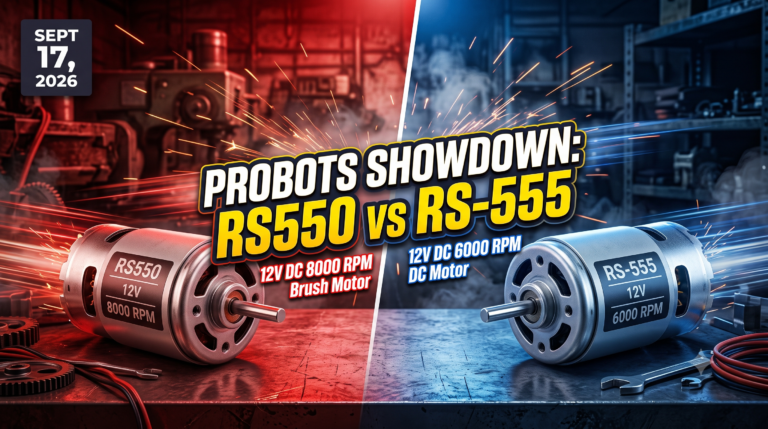
Showdown: RS550 12V DC 8000 vs RS-555 12V DC 6000 RPM DC Motor
Vol. 56 | The Heavyweight DC Drivetrain Duel Reliability isn’t optional when you’re designing actuators that need to move actual steel or
Read Article →
| Bulk Pricing | ||
|---|---|---|
| QTY | Unit Price(Inlc. GST) | |
| 10+ | ₹979.02 ₹ 829.68 + 149.34 GST | |
| 20+ | ₹969.03 ₹ 821.21 + 147.82 GST | |
| 30+ | ₹959.04 ₹ 812.75 + 146.3 GST | |
| 50+ | ₹939.06 ₹ 795.81 + 143.25 GST | |
Achieve whisper-quiet, ultra-smooth motion with the DM556 Digital Stepper Motor Driver. Features advanced DSP technology, up to 25600 microsteps, and a robust 5.6A peak current capacity. Perfectly drives NEMA 17, 23, and 34 motors with native 5V-24V signal support.
Advanced DSP Digital Control If your CNC router or 3D printer screams and vibrates at low speeds, your analog drivers are to blame. The DM556 utilizes a 32-bit DSP control algorithm to dynamically calculate and smooth out the electrical waveforms sent to the motor. This effectively eliminates low-speed resonance, meaning your motors will run whisper-quiet, generate significantly less heat, and provide vastly improved surface finishes on your machined parts.
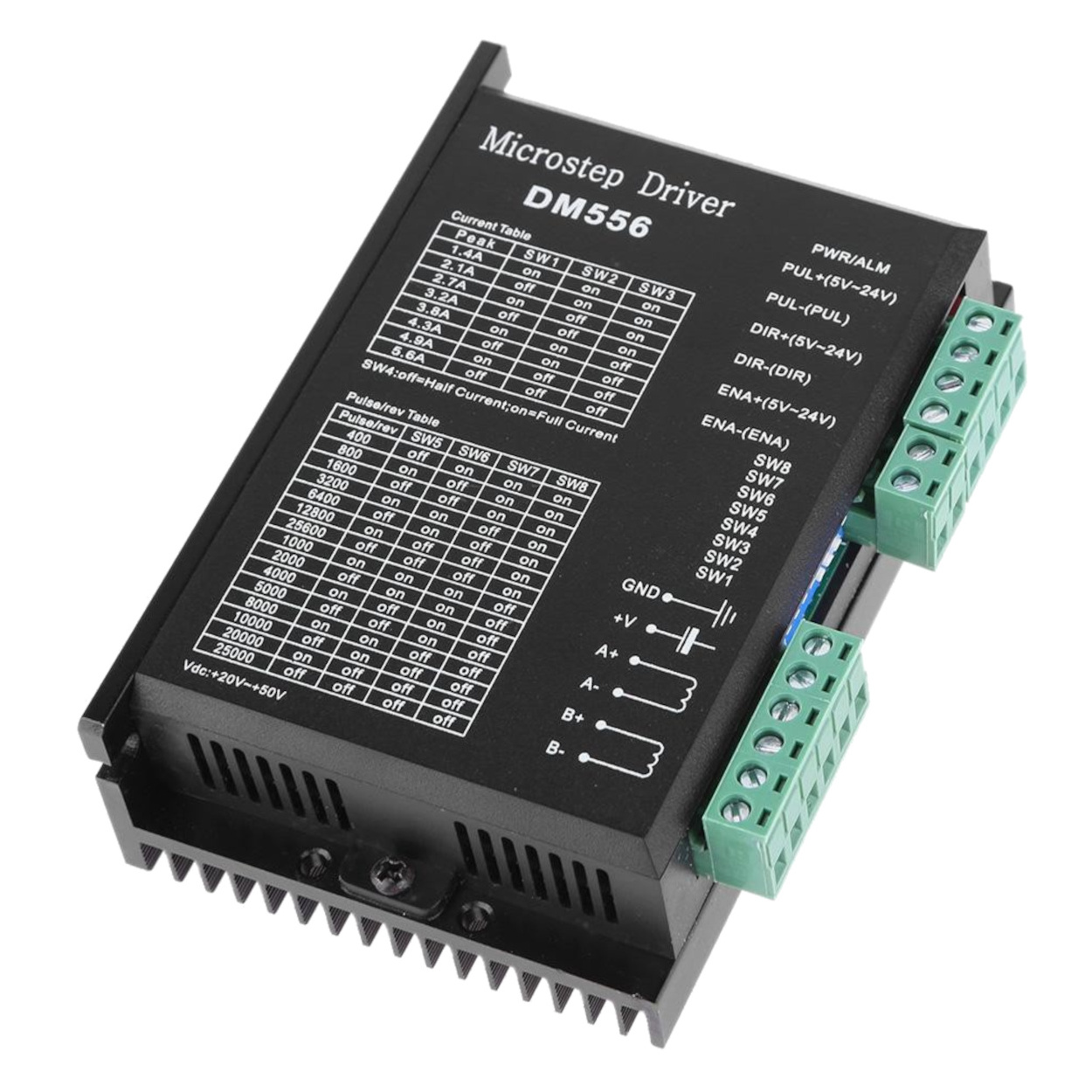
Native 5V-24V Logic Inputs A massive frustration with many industrial drivers is that they require a strict 5V logic signal, forcing you to wire clumsy external resistors to the terminals if you want to use a 24V PLC controller. The DM556 solves this natively. As clearly printed on the top panel, the PUL, DIR, and ENA optical isolator inputs accept anywhere from 5V to 24V DC directly. Whether you are driving it with a 5V Arduino Uno or a 24V industrial control board, it is entirely plug-and-play.
Massive Microstepping and Power Capacity This driver is built to push heavy iron. Capable of handling an input voltage of 20V to 50V DC and providing up to 5.6A of peak current, it easily dominates high-torque NEMA 23 and standard NEMA 34 motors. Furthermore, the 8-position DIP switch allows you to fine-tune the motor resolution all the way up to 25,600 pulses per revolution (128 microsteps), guaranteeing unparalleled positioning accuracy for laser engravers, pick-and-place machines, and heavy-duty mills.
Input Voltage: 20V to 50V DC (24V or 36V recommended)
Output Current: 1.4A to 5.6A Peak (Adjustable via SW1-SW3)
Logic Signal Voltage: 5V to 24V DC Compatible (No external resistors needed)
Microstep Resolution: 400 to 25600 steps/rev (Adjustable via SW5-SW8)
Control Method: Pulse (Step) and Direction (PUL/DIR)
Cooling: Heavy-duty black ribbed aluminum heatsink
DIY CNC Routers: Driving the heavy X and Y-axis NEMA 23 motors on custom ball-screw gantry mills for cutting aluminum and hardwoods.
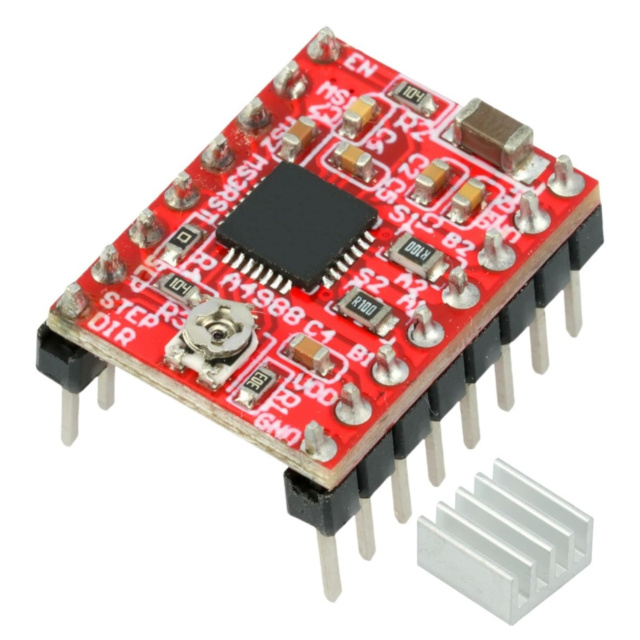
Large-Format 3D Printers: Upgrading from weak A4988 drivers to push large NEMA 17 extruders and heavy heated beds without skipping steps.
Automated Camera Sliders: Providing completely silent, vibration-free motion for cinematic time-lapse camera rigs.
Unlock New Capabilities (Project Evolution)
The Silent CNC Upgrade: Are you currently using a cheap TB6600 driver on your homemade CNC? Evolve your machine! Swap it out for the DM556. Because the DM556 uses active DSP resonance damping, your machine will instantly go from sounding like a grinding garbage disposal to running near-silently. Not only does this save your ears, but the reduction in vibration will noticeably eliminate "chatter marks" from your routed aluminum and acrylic parts!
1 x DM556 Digital Stepper Motor Driver
What does this module do? It takes low-power digital signals (steps) from a computer or Arduino and amplifies them into high-current power to accurately turn a heavy-duty stepper motor.
What size motors can the DM556 drive? It is perfect for large NEMA 17, all NEMA 23, and standard NEMA 34 two-phase or four-phase hybrid stepper motors.
What power supply voltage does it require? It requires a DC power supply between 20V and 50V DC. We highly recommend using a 24V or 36V power supply for the best balance of speed and cooling.
Can I power it with a 12V power supply? No. The minimum required voltage to wake up the internal logic and drive the motor properly is 20V DC. 12V will result in an under-voltage alarm.
How do I set the output current? Look at the printed chart on the top of the driver. Use the tiny white DIP switches labeled SW1, SW2, and SW3 to select the peak current that matches your specific motor's datasheet (from 1.4A up to 5.6A).
What does SW4 do? SW4 controls the idle current. If set to "OFF", the driver automatically cuts the current in half when the motor stops moving, significantly reducing heat buildup in the motor. If set to "ON", it provides full holding torque while idle.
Do I need to solder external resistors to the PUL and DIR pins if using a 24V PLC? No! This is a major feature of the DM556. The inputs are natively rated for 5V to 24V. You can wire 24V directly into the signal terminals without resistors.
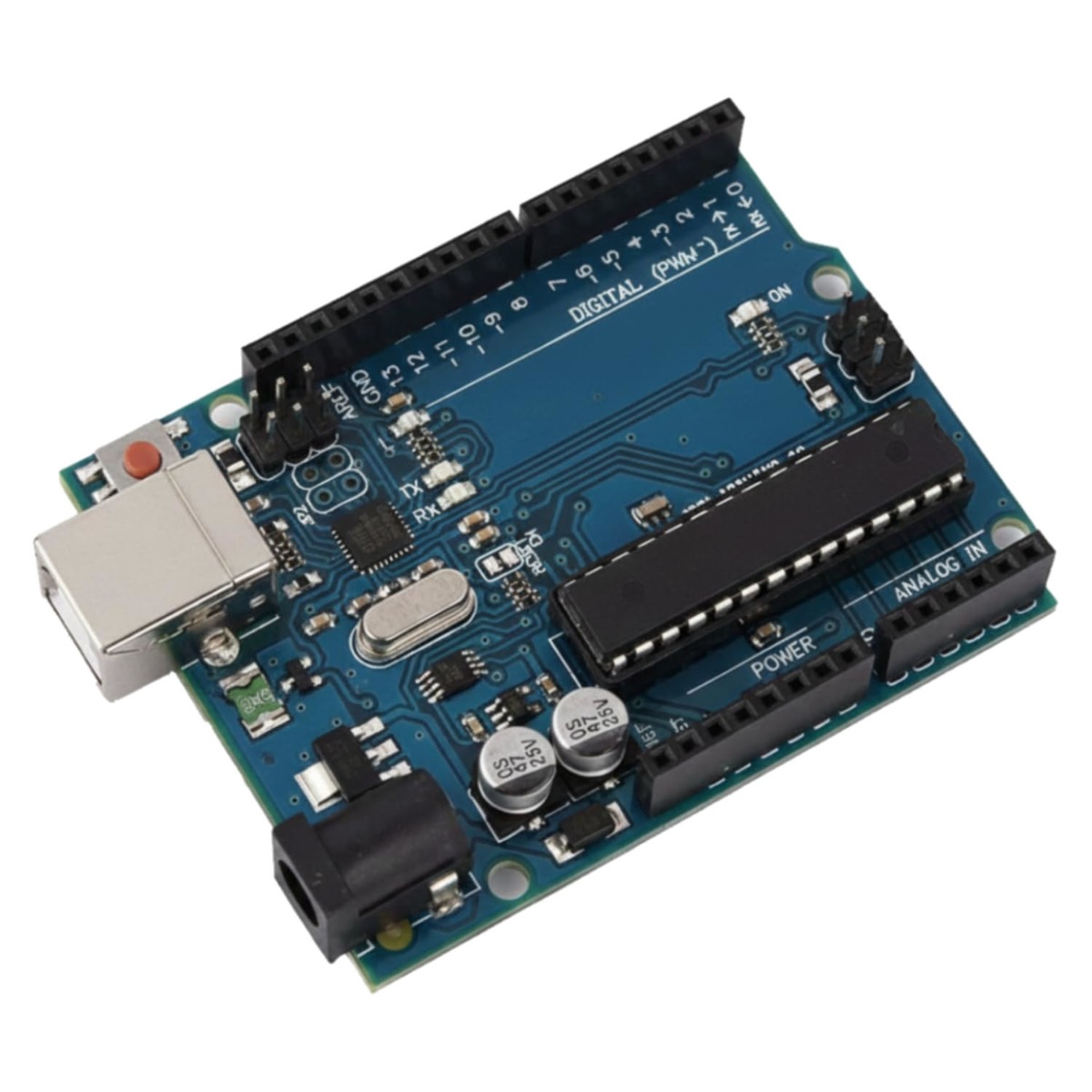
Will this work with a 5V Arduino or 3.3V ESP32? It works perfectly with 5V logic. For 3.3V logic (like an ESP32 or Raspberry Pi), it will usually trigger, but using a 3.3V-to-5V logic level shifter is recommended for maximum reliability.
What is microstepping? Stepper motors naturally move in chunky 1.8-degree steps. Microstepping breaks those chunks down into much smaller magnetic steps (up to 25600 per revolution), resulting in buttery-smooth motion.
How do I configure the microsteps? Use the printed "Pulse/rev Table" and flip switches SW5, SW6, SW7, and SW8 to choose your desired resolution.
How is this different from the TB6600? The TB6600 is a basic, noisy, analog driver. The DM556 is a digital DSP driver. It uses an internal processor to actively eliminate resonance, making the motor run significantly smoother, quieter, and cooler.
What does the "PUL" and "DIR" mean? PUL stands for Pulse (or Step)—every time this pin receives a signal, the motor moves one microstep. DIR stands for Direction—sending power to this pin tells the motor to spin clockwise or counter-clockwise.
What is the "ENA" terminal for? ENA stands for Enable. It allows your microcontroller to physically turn off the motor (allowing it to spin freely by hand). You typically do not need to wire anything to ENA; leaving it disconnected defaults to "Enabled."
How do I wire a 4-wire stepper motor to this? Identify your two motor coil pairs using a multimeter. Wire Coil A to the A+ and A- terminals. Wire Coil B to the B+ and B- terminals.
What happens if I wire A+ and A- backward? The motor will simply spin in the opposite direction. You can fix this by flipping the wires, or by simply reversing the direction pin in your software.
Why is there a red ALM light? The ALM (Alarm) LED will illuminate if the driver detects a fatal error, such as over-voltage, under-voltage, a short circuit in the motor wiring, or severe overheating.
Can I unplug the motor while the driver has power? Absolutely NOT. Disconnecting a stepper motor while the driver is actively sending power to it will cause a massive inductive voltage spike that instantly destroys the driver. Always power down first.
Does it need a cooling fan? The large black aluminum heatsink is highly efficient. If you run it under 4 Amps in a well-ventilated room, it relies on passive cooling. If you are pushing 5.6A inside a sealed control box, adding an exhaust fan is strongly recommended.
What happens if I reverse the +V and GND power wires? Reversing the main DC power polarity will bypass the protections and instantly fry the internal capacitors and MOSFETs. Always triple-check your power polarity before plugging it in.
Can I drive two motors from one DM556? It is highly discouraged. You should always use one driver per motor to ensure accurate current limiting and prevent skipped steps.
| Technical Details |
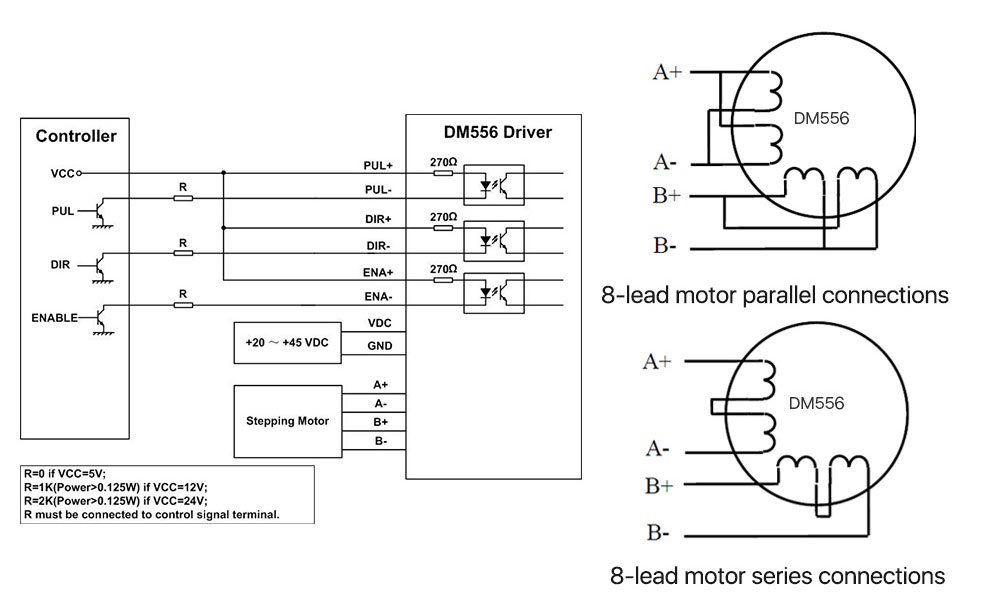
Probots DM556 Stepper Motor Connections with PLC / External Controller
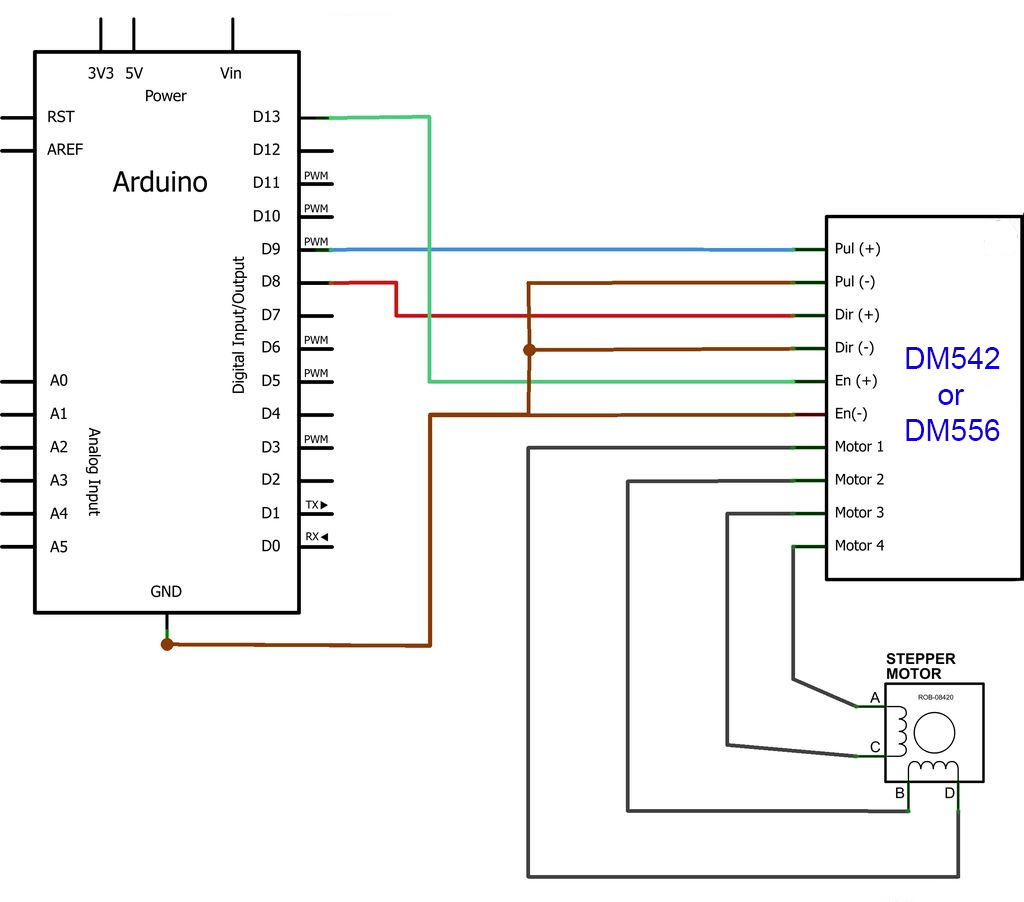
Probots DM556 Stepper Motor Connections with Arduino |
|---|---|
| Motor Type Supported | Stepper |
| Max Operating Voltage | 41-50V DC |
| Current (Max): | 0.3A - 5A |
| Max Motors Controlled(Nos) | 1 |
| Control Interface | Pulse/Dir |
| Step Resolution | Up to 1/256 |
| Feedback Type | NA |
Probots sells every Electronics Part for your next Project. You can order 10,000+ Electronic Parts Online - Arduino, Raspberry Pi, NodeMCU Development Boards, Sensors, Motors, Motor Drivers, SMPS, Plastic Enclosures etc in India directly on probots.co.in
We delivery electronics components and parts throughout India using standard couriers like Bluedart, Delhivery & India Post.
For order related queries contact -
This item is covered by a warranty of 7 days from the date of delivery, against confirmed manufacturing defects only, as verified by Probots' own testing and investigation. In case of a confirmed defect, we will replace the item — a refund is issued only if a replacement can't be supplied (e.g. discontinued or out of stock). Transit damage or a wrong item received must be reported within 3 days of delivery.
If the product shows signs of misuse, tampering, physical damage, static discharge, liquid or fire damage, use of unapproved chemicals, or has been soldered or physically altered in any way.
China
Probots sells every Electronics Part for your next Project. You can order 10,000+ Electronic Parts Online - Arduino, Raspberry Pi, NodeMCU Development Boards, Sensors, Motors, Motor Drivers, SMPS, Plastic Enclosures etc in India directly on probots.co.in
We offer specialized services for Bulk, Wholesale & B2B Customers like discounted prices, additional shipping options, customised products, etc . Customer with large quantity & regular orders qualify for the specialised discounted rates.
We also offer dedicated sales team to assist you with the order process by providing sales quotations, PI, technical support for choosing products, etc.
Note: Business Orders are processed manually and usually take 1-3 days to process compared to placing the order directly on our website. Please plan your purchases accordingly.
Need Help?
For bulk enquiries contact us by -
Probots Electronics is highly regarded for its highly skilled team and knowledgeable staff who provide expert guidance to ensure customers select the right components for their technical projects. The business maintains a strong reputation for prompt service and reliable support, with many clients praising their quick response times and genuine commitment to customer satisfaction.


A very great place for electronics Such a well maintained shop... Felt good shopping here


Nice

For new developments kit available and they will support till working, and I suggest this place strongly


This place has all the electronic parts students will ever need, staff is friendly and the place is organised.


It was a really nice experience! I was happy to find such a wide range of robotics kits for kids, suitable for different age groups and learning levels.

Excellent experience




Good stuff

Buyed them. But no bargain. Helpful staff.


Available all children school project spears parts like electronics


It was good experience




Staff is very patient and helpful

One of the best place for electronics you will get everything you want! With the best and orginal quality

Very helpful staff and the best place to buy components for projects

Wonderful store with expert service and technically strong people.

Prompt delivery, excellent technical support


Large inventory of electronic components and parts. Well trained service personnel and technicians who can quickly identify and rectify product defect if any. They are a reliable and trustworthy online stores.

A very great place for electronics Such a well maintained shop... Felt good shopping here
Nice
For new developments kit available and they will support till working, and I suggest this place strongly
This place has all the electronic parts students will ever need, staff is friendly and the place is organised.
It was a really nice experience! I was happy to find such a wide range of robotics kits for kids, suitable for different age groups and learning levels.
Excellent experience
Good stuff
Buyed them. But no bargain. Helpful staff.
Available all children school project spears parts like electronics
It was good experience
Staff is very patient and helpful
One of the best place for electronics you will get everything you want! With the best and orginal quality
Very helpful staff and the best place to buy components for projects
Wonderful store with expert service and technically strong people.
Prompt delivery, excellent technical support
Large inventory of electronic components and parts. Well trained service personnel and technicians who can quickly identify and rectify product defect if any. They are a reliable and trustworthy online stores.
● 20 min readVol. 56 | The Heavyweight DC Drivetrain Duel Reliability isn’t optional when you’re designing actuators that need to move actual steel or
Read Article → ● 13 min read
Workbench Vol. 49 🚀 The Project Trifecta: 3 Builds to Start Today We don’t just stock parts; we curate ecosystems. This week’s arrivals are desi
Read Article → ● 18 min read
Vol. 59 | The Battle of the Bite-Sized Boards Picture a project that needs full Linux, networking, and GPIO—but has almost no room for a conventional
Read Article →