





















 ● 20 min read
Showdown: RS550 12V DC 8000 vs RS-555 12V DC 6000 RPM DC Motor
Vol. 56 | The Heavyweight DC Drivetrain Duel Reliability isn’t optional when you’re designing actuators that need to move actual steel or
Read Article →
| Bulk Pricing | ||
|---|---|---|
| QTY | Unit Price(Inlc. GST) | |
| 10+ | ₹244.02 ₹ 206.8 + 37.22 GST | |
| 20+ | ₹241.53 ₹ 204.69 + 36.84 GST | |
| 30+ | ₹239.04 ₹ 202.58 + 36.46 GST | |
| 50+ | ₹234.06 ₹ 198.36 + 35.7 GST | |
Expand your flight controller's capabilities! This simple but essential I2C splitter board turns a single I2C port into five, allowing you to connect multiple peripherals like compasses, airspeed sensors, and displays simultaneously.
The "Not Enough Ports" Solution Modern flight controllers like the Pixhawk often only feature one main external I2C port. This quickly becomes a severe limitation when you need to connect an external compass (usually housed inside your GPS puck), a digital airspeed sensor for fixed-wing flight, and an LED status module. This expansion board provides a seamless plug-and-play solution, passively splitting one I2C bus into five identical ports.
Passive Parallel Architecture Because I2C (Inter-Integrated Circuit) is an addressable bus protocol, multiple devices can share the exact same physical data lines as long as each device possesses a unique hardware address. This board wires all five of its 4-pin connectors in perfect parallel (VCC, GND, SCL, SDA). You simply plug the included multi-colored cable from your flight controller into any port on the board, instantly leaving you with four open ports to plug in your peripherals.
Compact and Lightweight Design In drone building, every single gram matters. Measuring an incredibly compact 33.6mm by 12.7mm, this tiny breakout board adds virtually zero weight to your aircraft. Because it has a flat bottom with no protruding through-hole pins, it can be easily tucked inside a crowded drone frame and secured with a small piece of double-sided foam tape or enclosed in heat-shrink tubing to keep your wiring neat and safe from short circuits.
Specifications
Bus Type: I2C (Inter-Integrated Circuit)
Port Count: 5x 4-Pin Connectors (Wired in parallel)
Connector Pitch: 1.25mm (Standard for APM/Pixhawk 2.4.8)
Dimensions: 33.6mm (Length) x 12.7mm (Width)
Circuit Type: Passive Breakout / Hub (No active logic)
Cable: 4-Wire Multi-color (Red, Black, Yellow, Green)
Key Applications and Projects
Advanced UAV Builds: Connecting a primary GPS/Compass, a secondary redundant backup compass, and a digital airspeed sensor to a single Pixhawk controller.
Custom Sensor Arrays: Adding environmental monitoring I2C sensors alongside flight-critical I2C hardware on custom robotic rovers.
Status Indicators: Wiring an external I2C RGB LED module or an OLED screen to view drone telemetry statuses without needing a computer connection.
Unlock New Capabilities (Project Evolution) The Autonomous Fixed-Wing Mapper: If you are building a fixed-wing drone for aerial mapping, you need multiple streams of telemetry. Evolve your build! Use this expansion board to connect a digital airspeed sensor (crucial for precise throttle control to prevent stalling), an external compass (to escape the magnetic interference of your motor), and an I2C OLED screen. You can verify your pre-flight checks and satellite lock directly on the fuselage without ever opening your laptop or pulling out a telemetry radio!
1 x 5-Port I2C Expansion Board
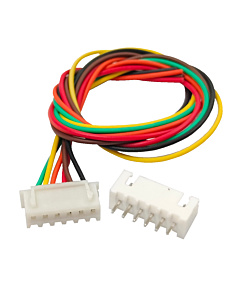
1 x 4-Wire Connection Cable (Pre-crimped 4-pin connectors on both ends)

1. What is an I2C expansion board used for? It is used to split a single I2C port into multiple ports. Since I2C devices use unique addresses, multiple sensors can communicate over the same two data lines (SDA and SCL).
2. Does it matter which port I plug the flight controller into? No. Because all five ports on the circuit board are wired in parallel, they are completely identical. You can use any port as the "Input" from the flight controller.
3. Can I plug in two identical I2C devices? Generally, no. If you plug in two identical devices (like two of the exact same compasses), they will have the same hardware address. This causes an address conflict, and the flight controller won't be able to communicate with either of them.
4. How do I fix an I2C address conflict? Many I2C sensors have a solder jumper on their circuit board that allows you to change their I2C address (e.g., from 0x3C to 0x3D). If you change the address of one device, you can use them both on this expansion board.
5. Do I need to provide extra power to this board? No. This is a passive board. It draws 5V or 3.3V power (VCC) directly from the flight controller's I2C port and distributes it to the attached peripherals.
6. What connector type does this board use? It uses a 1.25mm pitch 4-pin connector. This is the standard connector type used on the APM 2.6, APM 2.8, and the popular Pixhawk 2.4.8 flight controllers.
7. Is this board an active hub or a passive splitter? It is a purely passive splitter. There are no microchips or logic gates on this board; it simply connects the pins of all five ports together.
8. Will this work with a Pixhawk 4 or Cube Orange? You must check your specific flight controller's connector type. Newer Pixhawk variants (like the Pixhawk 4) often use JST-GH connectors, while this board typically ships with connectors suited for older Molex Picoblade / JST 1.25mm standards.
9. What do the four wires in the cable represent? While wire colors can vary, they represent the four lines required for I2C: VCC (Power), GND (Ground), SCL (Serial Clock), and SDA (Serial Data).
10. How many total devices can I connect? The board has 5 ports. One port is used to connect to the flight controller, leaving 4 ports available for your I2C devices.
11. Can I daisy-chain two of these boards together? Physically, yes. However, adding too many wires and devices increases the capacitance on the I2C bus, which can degrade the signal and cause sensor dropouts. It is best to keep I2C wire runs as short as possible.
12. What are the exact dimensions of the board? The printed circuit board measures 33.6mm in length and 12.7mm in width.
13. Will this work with an Arduino or Raspberry Pi? Yes, the I2C protocol is universal. However, you will likely need to cut one end of the included cable and crimp standard DuPont connectors onto the wires to plug it into an Arduino's header pins.
14. Do the cable colors match the pinout standardized colors? Not always. Never rely solely on wire color (Red is usually VCC, Black is GND). Always trace the pinout from your flight controller's manual to ensure VCC aligns with VCC on your sensor to avoid damaging your equipment.
15. Does this board process or filter the data? No. It does not contain any pull-up resistors or data filters. It is simply a physical wire bridge.
16. Can I use this board to split a UART or Serial port (Telemetry)? No. While a telemetry port also uses 4 pins (VCC, GND, TX, RX), UART is a point-to-point protocol. If you use this board to split a TX line to multiple devices, the data signals will collide and become corrupted.
17. How should I mount this to my drone? Because the board does not have mounting holes, the best method is to use a small square of double-sided foam mounting tape to stick it to your drone's frame or power distribution board cover.
18. Will using this hub increase the latency of my sensors? No, the electrical connection is virtually instantaneous. Any latency would solely be due to the flight controller having to poll a higher number of devices via software.
19. Are the pins on the board through-hole or SMD? The 4-pin connectors are surface-mounted (SMD) to the PCB. You should avoid pulling violently on the cables, as excessive force could rip the plastic connector off the circuit board.
20. Why do I need an external compass if my Pixhawk has an internal one? Internal compasses are heavily affected by the electromagnetic interference generated by the drone's power distribution board and spinning motors. Mounting an external compass high up on a GPS mast and connecting it via this I2C board guarantees clean, interference-free heading data.
Probots sells every Electronics Part for your next Project. You can order 10,000+ Electronic Parts Online - Arduino, Raspberry Pi, NodeMCU Development Boards, Sensors, Motors, Motor Drivers, SMPS, Plastic Enclosures etc in India directly on probots.co.in
We delivery electronics components and parts throughout India using standard couriers like Bluedart, Delhivery & India Post.
For order related queries contact -
This item is covered by a warranty of 7 days from the date of delivery, against confirmed manufacturing defects only, as verified by Probots' own testing and investigation. In case of a confirmed defect, we will replace the item — a refund is issued only if a replacement can't be supplied (e.g. discontinued or out of stock). Transit damage or a wrong item received must be reported within 3 days of delivery.
If the product shows signs of misuse, tampering, physical damage, static discharge, liquid or fire damage, use of unapproved chemicals, or has been soldered or physically altered in any way.
China
Probots sells every Electronics Part for your next Project. You can order 10,000+ Electronic Parts Online - Arduino, Raspberry Pi, NodeMCU Development Boards, Sensors, Motors, Motor Drivers, SMPS, Plastic Enclosures etc in India directly on probots.co.in
We offer specialized services for Bulk, Wholesale & B2B Customers like discounted prices, additional shipping options, customised products, etc . Customer with large quantity & regular orders qualify for the specialised discounted rates.
We also offer dedicated sales team to assist you with the order process by providing sales quotations, PI, technical support for choosing products, etc.
Note: Business Orders are processed manually and usually take 1-3 days to process compared to placing the order directly on our website. Please plan your purchases accordingly.
Need Help?
For bulk enquiries contact us by -

Probots Electronics is highly regarded for its highly skilled team and knowledgeable staff who provide expert guidance to ensure customers select the right components for their technical projects. The business maintains a strong reputation for prompt service and reliable support, with many clients praising their quick response times and genuine commitment to customer satisfaction.


A very great place for electronics Such a well maintained shop... Felt good shopping here


Nice

For new developments kit available and they will support till working, and I suggest this place strongly


This place has all the electronic parts students will ever need, staff is friendly and the place is organised.


It was a really nice experience! I was happy to find such a wide range of robotics kits for kids, suitable for different age groups and learning levels.

Excellent experience




Good stuff

Buyed them. But no bargain. Helpful staff.


Available all children school project spears parts like electronics


It was good experience




Staff is very patient and helpful

One of the best place for electronics you will get everything you want! With the best and orginal quality

Very helpful staff and the best place to buy components for projects

Wonderful store with expert service and technically strong people.

Prompt delivery, excellent technical support


Large inventory of electronic components and parts. Well trained service personnel and technicians who can quickly identify and rectify product defect if any. They are a reliable and trustworthy online stores.

A very great place for electronics Such a well maintained shop... Felt good shopping here
Nice
For new developments kit available and they will support till working, and I suggest this place strongly
This place has all the electronic parts students will ever need, staff is friendly and the place is organised.
It was a really nice experience! I was happy to find such a wide range of robotics kits for kids, suitable for different age groups and learning levels.
Excellent experience
Good stuff
Buyed them. But no bargain. Helpful staff.
Available all children school project spears parts like electronics
It was good experience
Staff is very patient and helpful
One of the best place for electronics you will get everything you want! With the best and orginal quality
Very helpful staff and the best place to buy components for projects
Wonderful store with expert service and technically strong people.
Prompt delivery, excellent technical support
Large inventory of electronic components and parts. Well trained service personnel and technicians who can quickly identify and rectify product defect if any. They are a reliable and trustworthy online stores.
● 20 min readVol. 56 | The Heavyweight DC Drivetrain Duel Reliability isn’t optional when you’re designing actuators that need to move actual steel or
Read Article → ● 13 min read
Workbench Vol. 49 🚀 The Project Trifecta: 3 Builds to Start Today We don’t just stock parts; we curate ecosystems. This week’s arrivals are desi
Read Article → ● 18 min read
Vol. 59 | The Battle of the Bite-Sized Boards Picture a project that needs full Linux, networking, and GPIO—but has almost no room for a conventional
Read Article →