










 ● 20 min read
Showdown: RS550 12V DC 8000 vs RS-555 12V DC 6000 RPM DC Motor
Vol. 56 | The Heavyweight DC Drivetrain Duel Reliability isn’t optional when you’re designing actuators that need to move actual steel or
Read Article →
| Bulk Pricing | ||
|---|---|---|
| QTY | Unit Price(Inlc. GST) | |
| 25+ | ₹97.02 ₹ 82.22 + 14.8 GST | |
| 50+ | ₹96.03 ₹ 81.38 + 14.65 GST | |
| 75+ | ₹95.04 ₹ 80.54 + 14.5 GST | |
| 100+ | ₹93.06 ₹ 78.86 + 14.19 GST | |
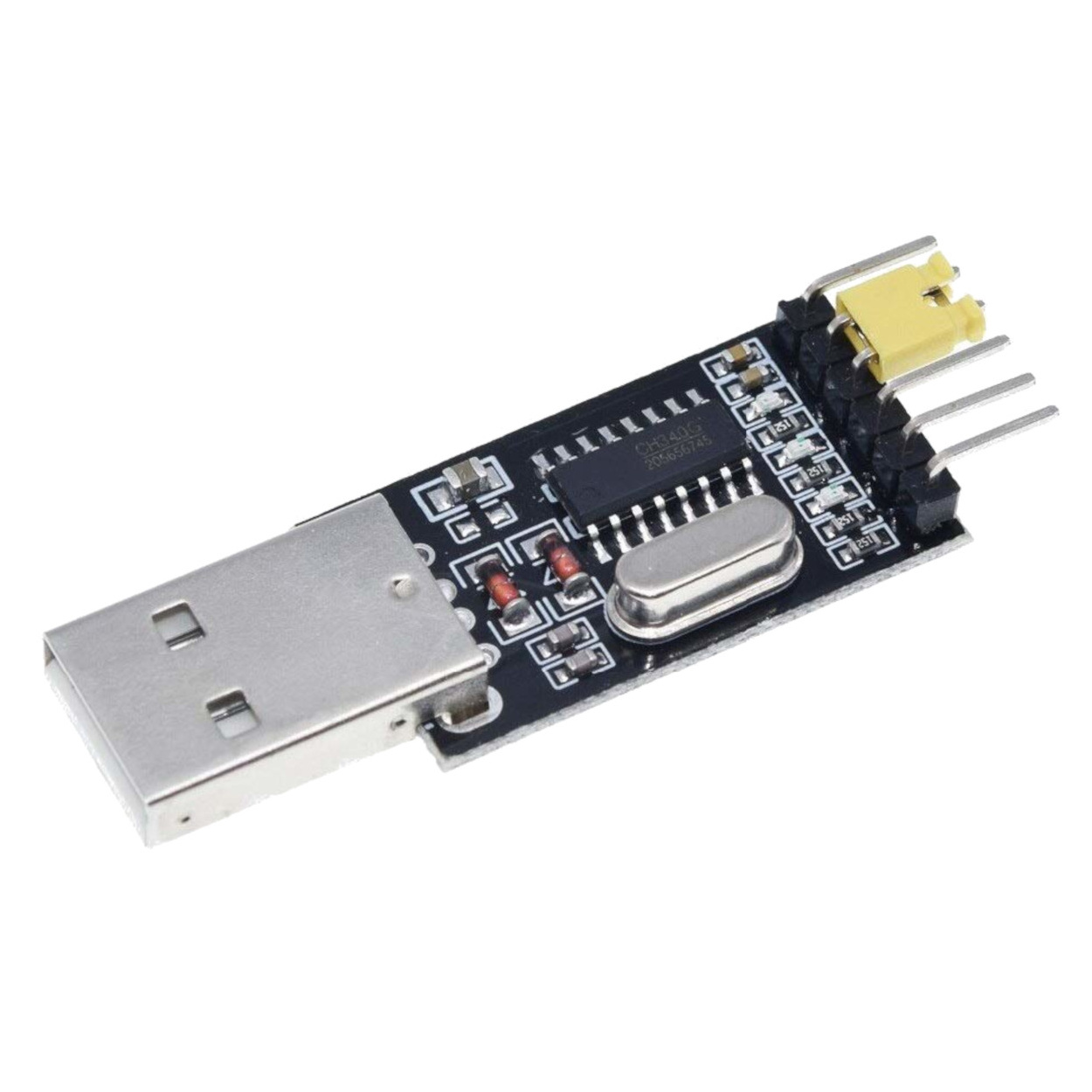
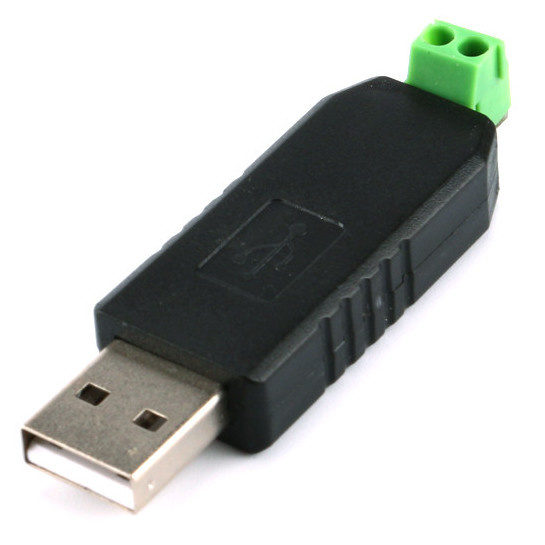
Easily program ESP boards and interface with raw UART hardware! This cost-effective CH340G module converts USB to TTL serial. Features a built-in voltage selection jumper (3.3V/5V), a direct USB-A plug, and onboard TX/RX indicator LEDs.
The CH340G Architecture While FTDI chips are common, the CH340G has rapidly become the backbone of modern open-source hardware due to its incredible cost-to-performance ratio. Once the universal WCH drivers are installed on your operating system, this module creates a highly stable Virtual COM port. Unlike cheaper ICs that rely on internal timing, this specific module board features a dedicated 12.000 MHz external crystal oscillator. This guarantees rock-solid timing accuracy at high baud rates (up to 2 Mbps), preventing data corruption when flashing large firmware binaries.
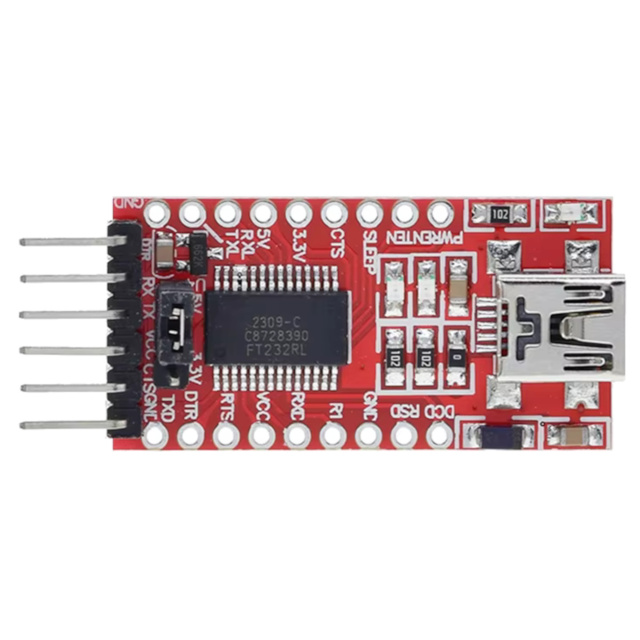
Selectable 3.3V & 5V Logic Levels The electronics ecosystem is split between traditional 5V hardware (like standard Arduinos) and modern 3.3V processors (like the ESP32 or Raspberry Pi). Sending a 5V transmission signal into a 3.3V chip will fatally damage the processor. This module prevents this via a physical yellow jumper block. By bridging the central VCC pin to either the 5V pin or the 3V3 pin, you simultaneously set the power output voltage AND the logic-level voltage of the TX and RX data lines, keeping your delicate sensors perfectly safe.
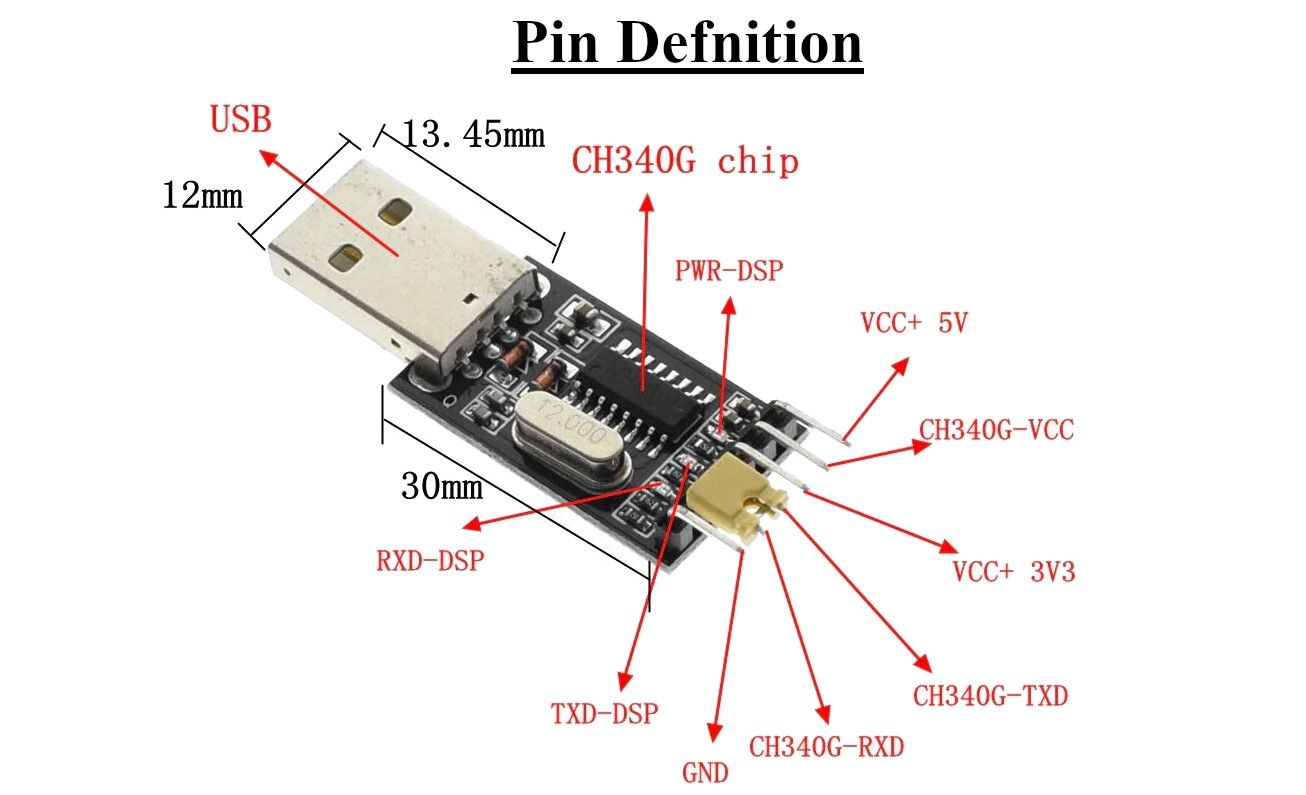
Direct USB-A Form Factor & Visual Diagnostics Forget digging around for the correct mini or micro USB cable. This module features a rigid, male USB Type-A connector integrated directly into the PCB, allowing you to plug it straight into your laptop or a USB extension cable. During operation, debugging is made simple with three onboard surface-mount LEDs. The PWR-DSP LED confirms the board is receiving USB power, while the TXD-DSP and RXD-DSP LEDs flash independently to visually confirm data transmission and reception, immediately ruling out wiring faults.
Specifications
Core IC: WCH CH340G
USB Interface: Standard USB Type-A Male
Operating Logic Voltage: 3.3V or 5V (Selectable via physical jumper)
Pinout: 5V, VCC, 3V3, TXD, RXD, GND
Baud Rates: 50 bps to 2 Mbps
Timing: 12.000 MHz External Crystal Oscillator
LED Indicators: Power, TX Traffic, RX Traffic
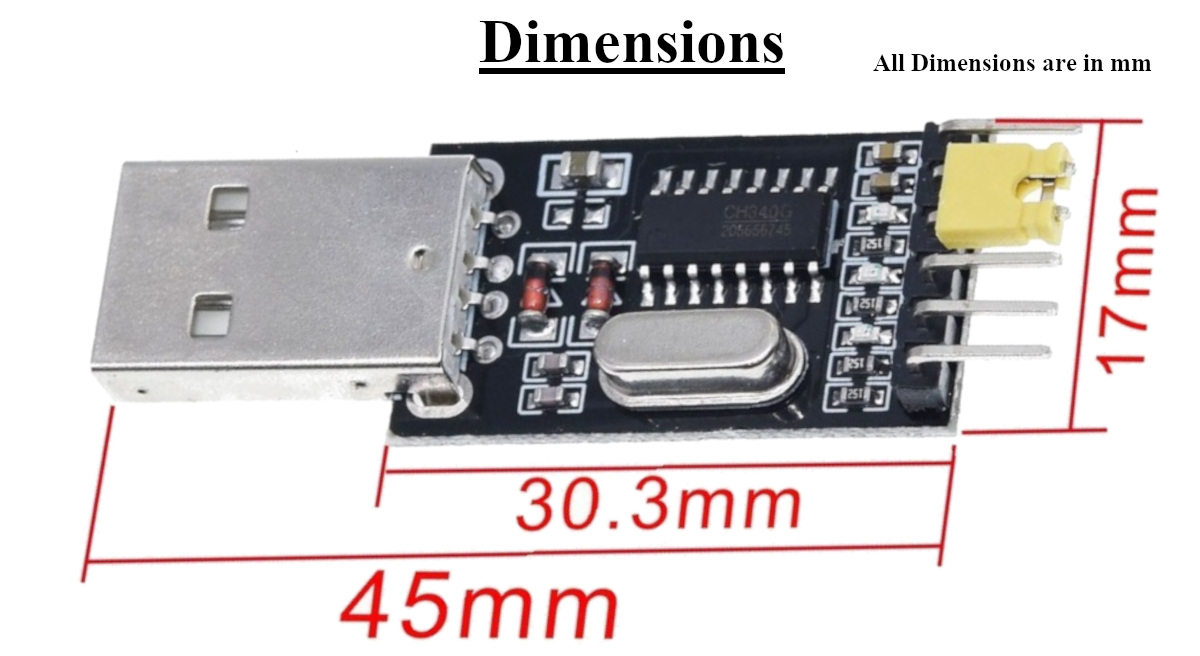
Dimensions: ~45mm x 17mm x 6mm
Supported OS: Windows (7/10/11), macOS, Linux
Key Applications and Projects
ESP8266 / ESP32 Flashing: Providing the 3.3V serial interface necessary to upload custom IoT firmware (like Tasmota or ESPHome) to bare ESP-01 modules.
Headless Raspberry Pi Console: Logging directly into a Raspberry Pi's Linux terminal via its GPIO UART pins when you don't have a monitor or network connection available.
Router & Modem Unbricking: Connecting to the hidden UART diagnostic headers inside dead Wi-Fi routers to interrupt the bootloader and flash fresh firmware via TFTP.
GPS Module Interfacing: Testing NMEA sentence outputs from raw GPS modules directly on your PC terminal before integrating them into a microcontroller circuit.
Unlock New Capabilities (Project Evolution) The ESP-01 Mass-Programming Jig: Are you building a swarm of Wi-Fi temperature sensors? Flashing bare ESP-01 modules with loose jumper wires is tedious. Evolve your workflow! Take a small piece of perfboard and solder an 8-pin female header to accept the ESP-01. Wire the RX, TX, and GND to this CH340G module. Add a small tactile push-button bridging the ESP's GPIO0 pin to Ground. Plug the CH340G directly into your PC (set to 3.3V logic!). Now, you can drop an ESP-01 into the socket, hold the button, apply power, and flash your code in seconds. You have just built a factory-style programming jig!
1 x CH340G USB to TTL Serial Converter Module (Black)
1 x Yellow 2-Pin Shunt Jumper (Pre-installed)
Q: The title says RS232, does this output true RS232 voltage? No. This is a very common marketing misconception. This module outputs TTL (Transistor-Transistor Logic) signals operating at 0V to 5V (or 3.3V). True RS232 operates at -12V to +12V. Do not wire this directly to an old 9-pin RS232 serial port without a MAX232 level-shifting chip in between.
Q: How do I switch between 3.3V and 5V logic? Locate the 3 exposed pins on the side (5V, VCC, 3V3) and the yellow jumper cap. To use 5V logic, place the cap over the 5V and VCC pins. To use 3.3V logic, move the cap to cover the 3V3 and VCC pins.
Q: Does moving the jumper change the TX and RX voltage levels? Yes. The jumper determines the reference voltage for the CH340G chip. Setting it to 3.3V ensures the TX logic level drops to a safe 3.3V.
Q: Do I need to install drivers for the CH340G? Yes. Unlike FTDI chips which are often baked into modern OS updates, you typically need to download and install the official "WCH CH340 Driver" for Windows or macOS for the virtual COM port to appear.
Q: Where is the DTR pin for auto-resetting Arduinos? This specific 6-pin module design does not break out the DTR pin. It is designed purely for standard serial communication and manual flashing.
Q: How do I program an Arduino Pro Mini without a DTR pin? You must reset the board manually. Hold down the physical reset button on your Arduino Pro Mini, click "Upload" in the Arduino IDE, and release the reset button the exact moment the IDE text changes from "Compiling" to "Uploading".
Q: Can I use this to program an ESP8266? Absolutely. Ensure the jumper is strictly set to 3.3V. Connect TX to RX, RX to TX, and GND to GND. Remember that you must manually ground the GPIO0 pin on the ESP module on boot to enter flash mode.
Q: What do the onboard LEDs mean? The PWR-DSP LED illuminates continuously to show the board has USB power. The TXD-DSP flashes when your PC is transmitting data, and the RXD-DSP flashes when the target device replies.
Q: How do I wire the TX and RX pins? Serial data must cross over. Wire the CH340G TX (Transmit) to the target board's RX (Receive). Wire the CH340G RX to the target board's TX.
Q: Is it mandatory to connect the GND pin? Yes! You must always connect the GND pin on this module to the GND of your target microcontroller to establish a common electrical reference, otherwise, the data signals will be garbled.
Q: What is the maximum baud rate supported? The CH340G, supported by the onboard 12MHz crystal, can handle high-speed baud rates up to 2 Mbps.
Q: Can I power my circuit directly from the VCC pin? If set to 5V, the VCC pin can supply up to ~400mA directly from the USB port. If set to 3.3V, the power is drawn from the CH340G's internal low-dropout regulator, which maxes out around 50mA. Do not power heavy loads (like an actively transmitting ESP8266) from the 3.3V pin.
Q: Will this work with a Raspberry Pi? Yes. You can plug it into a PC and wire it to the Raspberry Pi's GPIO UART pins to access the serial console. Just ensure the jumper is set to 3.3V to protect the Pi's logic pins.
Q: What is the silver oval component on the board? That is a 12.000 MHz crystal oscillator. It provides a highly accurate timing heartbeat to the CH340G chip, ensuring serial data packets stay synchronized at high speeds.
Q: My computer says "USB Device Not Recognized", how do I fix this? This almost always indicates a missing driver. Download the latest CH340/CH341 driver package from the WCH website. If it still fails, ensure the module is plugged directly into the PC and not through an unpowered USB hub.
Q: Can I remove the yellow jumper completely? If you remove the jumper cap, the central VCC pin will not output any power, and the logic voltage of the IC may float unpredictably. The jumper must bridge VCC to either 3V3 or 5V for stable operation.
Q: Can I use this with Windows 11? Yes, the latest WCH drivers fully support Windows 11.
Q: Is this compatible with macOS Apple Silicon (M1/M2/M3)? Yes, WCH provides updated, signed drivers for modern macOS architectures, though installation may require approving the driver in your Mac's Security & Privacy settings.
Q: What happens if I accidentally leave it on 5V and connect it to a 3.3V sensor? Sending a 5V signal into a sensor or microcontroller that is strictly rated for 3.3V logic (like a GPS module or an ESP32) will typically cause permanent electrical damage to the target device. Always check the jumper before connecting!
Q: Can I plug dupont jumper wires directly onto these pins? Yes, the 6-pin male header features standard 2.54mm (0.1") pitch spacing, perfectly accommodating standard female-to-female dupont jumper cables.
Probots sells every Electronics Part for your next Project. You can order 10,000+ Electronic Parts Online - Arduino, Raspberry Pi, NodeMCU Development Boards, Sensors, Motors, Motor Drivers, SMPS, Plastic Enclosures etc in India directly on probots.co.in
We delivery electronics components and parts throughout India using standard couriers like Bluedart, Delhivery & India Post.
For order related queries contact -
This item is covered by a warranty of 7 days from the date of delivery, against confirmed manufacturing defects only, as verified by Probots' own testing and investigation. In case of a confirmed defect, we will replace the item — a refund is issued only if a replacement can't be supplied (e.g. discontinued or out of stock). Transit damage or a wrong item received must be reported within 3 days of delivery.
If the product shows signs of misuse, tampering, physical damage, static discharge, liquid or fire damage, use of unapproved chemicals, or has been soldered or physically altered in any way.
China
Probots sells every Electronics Part for your next Project. You can order 10,000+ Electronic Parts Online - Arduino, Raspberry Pi, NodeMCU Development Boards, Sensors, Motors, Motor Drivers, SMPS, Plastic Enclosures etc in India directly on probots.co.in
We offer specialized services for Bulk, Wholesale & B2B Customers like discounted prices, additional shipping options, customised products, etc . Customer with large quantity & regular orders qualify for the specialised discounted rates.
We also offer dedicated sales team to assist you with the order process by providing sales quotations, PI, technical support for choosing products, etc.
Note: Business Orders are processed manually and usually take 1-3 days to process compared to placing the order directly on our website. Please plan your purchases accordingly.
Need Help?
For bulk enquiries contact us by -
Probots Electronics is highly regarded for its highly skilled team and knowledgeable staff who provide expert guidance to ensure customers select the right components for their technical projects. The business maintains a strong reputation for prompt service and reliable support, with many clients praising their quick response times and genuine commitment to customer satisfaction.


A very great place for electronics Such a well maintained shop... Felt good shopping here


Nice

For new developments kit available and they will support till working, and I suggest this place strongly


This place has all the electronic parts students will ever need, staff is friendly and the place is organised.


It was a really nice experience! I was happy to find such a wide range of robotics kits for kids, suitable for different age groups and learning levels.

Excellent experience




Good stuff

Buyed them. But no bargain. Helpful staff.


Available all children school project spears parts like electronics


It was good experience




Staff is very patient and helpful

One of the best place for electronics you will get everything you want! With the best and orginal quality

Very helpful staff and the best place to buy components for projects

Wonderful store with expert service and technically strong people.

Prompt delivery, excellent technical support


Large inventory of electronic components and parts. Well trained service personnel and technicians who can quickly identify and rectify product defect if any. They are a reliable and trustworthy online stores.

A very great place for electronics Such a well maintained shop... Felt good shopping here
Nice
For new developments kit available and they will support till working, and I suggest this place strongly
This place has all the electronic parts students will ever need, staff is friendly and the place is organised.
It was a really nice experience! I was happy to find such a wide range of robotics kits for kids, suitable for different age groups and learning levels.
Excellent experience
Good stuff
Buyed them. But no bargain. Helpful staff.
Available all children school project spears parts like electronics
It was good experience
Staff is very patient and helpful
One of the best place for electronics you will get everything you want! With the best and orginal quality
Very helpful staff and the best place to buy components for projects
Wonderful store with expert service and technically strong people.
Prompt delivery, excellent technical support
Large inventory of electronic components and parts. Well trained service personnel and technicians who can quickly identify and rectify product defect if any. They are a reliable and trustworthy online stores.
● 20 min readVol. 56 | The Heavyweight DC Drivetrain Duel Reliability isn’t optional when you’re designing actuators that need to move actual steel or
Read Article → ● 13 min read
Workbench Vol. 49 🚀 The Project Trifecta: 3 Builds to Start Today We don’t just stock parts; we curate ecosystems. This week’s arrivals are desi
Read Article → ● 18 min read
Vol. 59 | The Battle of the Bite-Sized Boards Picture a project that needs full Linux, networking, and GPIO—but has almost no room for a conventional
Read Article →