






















 ● 20 min read
Showdown: RS550 12V DC 8000 vs RS-555 12V DC 6000 RPM DC Motor
Vol. 56 | The Heavyweight DC Drivetrain Duel Reliability isn’t optional when you’re designing actuators that need to move actual steel or
Read Article →
| Bulk Pricing | ||
|---|---|---|
| QTY | Unit Price(Inlc. GST) | |
| 25+ | ₹234.22 ₹ 198.49 + 35.73 GST | |
| 50+ | ₹231.83 ₹ 196.47 + 35.36 GST | |
| 75+ | ₹229.44 ₹ 194.44 + 35 GST | |
| 100+ | ₹224.66 ₹ 190.39 + 34.27 GST | |
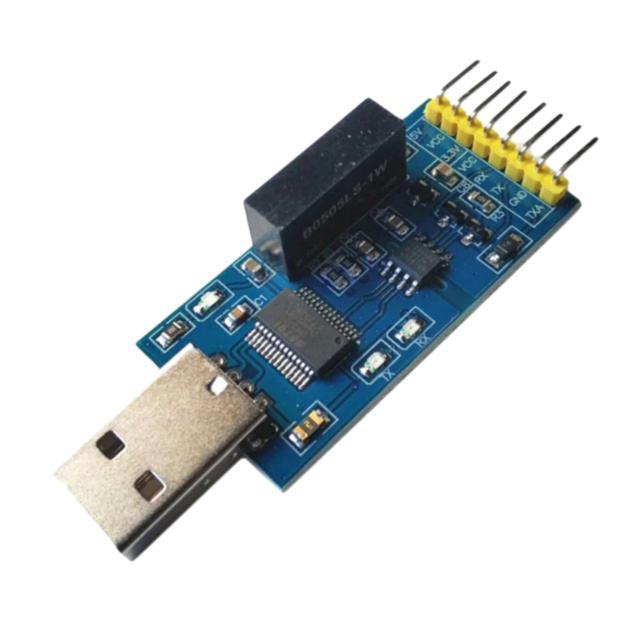
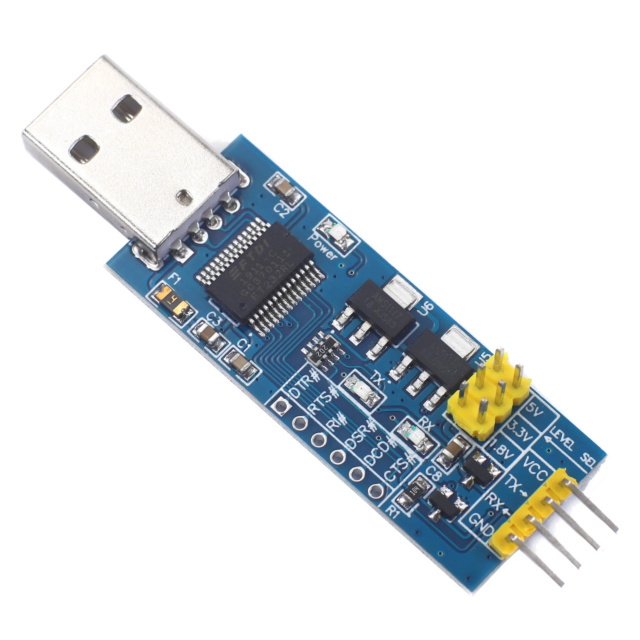
The industry standard for hardware debugging! Program Arduino Pro Minis, debug ESP microcontrollers, and interface with raw UART hardware. Features a reliable FT232 chip, Mini-USB port, auto-reset DTR pin, and a jumper for instant 3.3V or 5V logic selection.
The Rock-Solid FTDI Standard In the world of USB-to-Serial converters, the FTDI FT232RL architecture is legendary for its stability. While cheaper chips like the CH340 or CP2102 exist, the FT232 series boasts unmatched driver compatibility across Windows, Mac, and Linux systems. It establishes a Virtual COM port on your machine that simply works, refusing to drop packets even at high baud rates. Furthermore, the 6-pin header arrangement on this module perfectly matches the "FTDI Standard" pinout, allowing you to plug it directly into the programming headers of countless open-source development boards.
Dual Voltage Capability (3.3V & 5V) Modern microcontrollers are deeply divided. Standard Arduinos run on 5V logic, while powerful chips like the ESP8266, ESP32, and Raspberry Pi Pico run strictly on 3.3V logic. Hitting a 3.3V RX pin with a 5V TX signal will instantly destroy the microcontroller. This module features an onboard jumper block. By physically moving the black jumper cap across the three designated pins, you switch both the VCC power output pin AND the logic-level voltage of the TX and RX data lines simultaneously, keeping your delicate sensors and 32-bit chips perfectly safe.
Auto-Reset Functionality (The DTR Pin) Early serial programmers only had RX, TX, VCC, and GND. This meant you had to manually press the reset button on your Arduino at the exact millisecond the IDE began compiling to upload code. This FTDI module breaks out the DTR (Data Terminal Ready) pin. The Arduino IDE pulses this pin LOW right before uploading, which triggers the microcontroller's reset sequence automatically. This provides a seamless, one-click upload experience identical to using a standard Arduino Uno.
Visual Debugging LEDs When communication fails, diagnosing the issue is notoriously frustrating. This module features two dedicated surface-mount LEDs wired directly to the RX and TX lines. When your computer sends data, the TX LED flashes. When the target device responds, the RX LED flashes. This instant visual feedback tells you immediately if your wiring is correct and if the baud rates are synchronized.
Specifications
Core IC: FT232RL (FTDI Architecture)
USB Interface: Mini-USB Female
Operating Logic Voltage: 3.3V or 5V (Selectable via physical jumper)
Output Power (VCC): 5V (up to ~500mA from USB) or 3.3V (up to ~50mA from internal LDO)
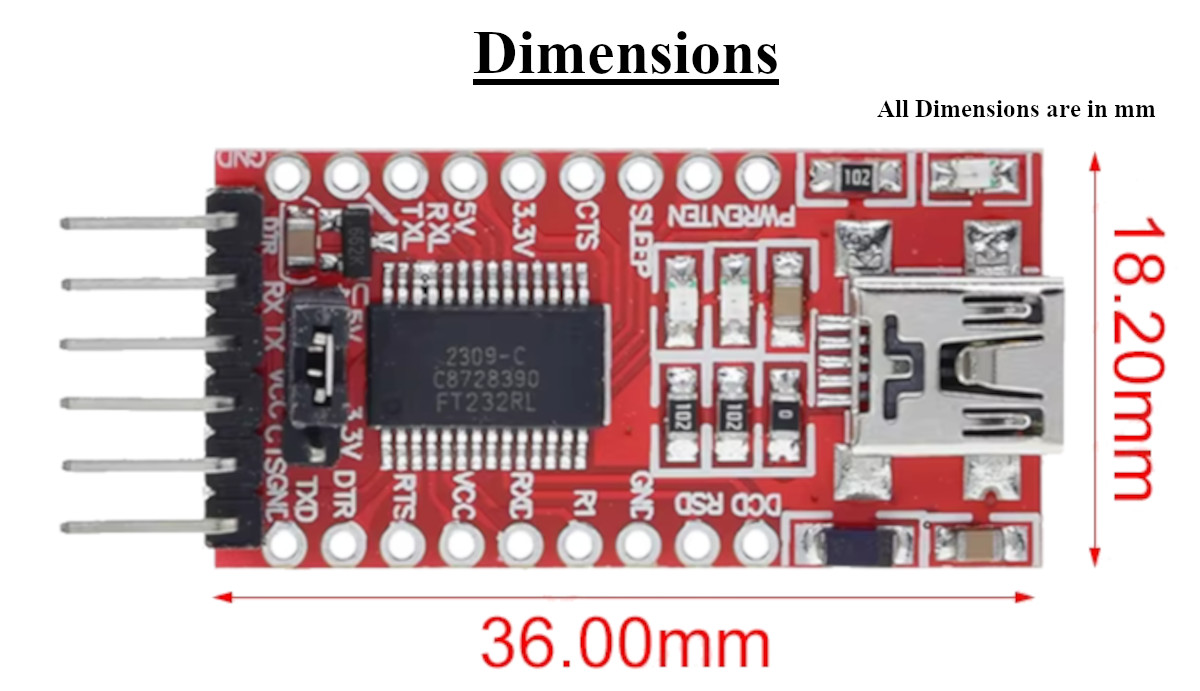
Pinout: DTR, RX, TX, VCC, CTS, GND
Supported Baud Rates: 300 bps to 3 Mbps
LED Indicators: Power, TX Traffic, RX Traffic
Dimensions: 36.00mm x 18.20mm
Supported OS: Windows 10/11, macOS, Linux, Android
Key Applications and Projects
Programming "Bare" Microcontrollers: The mandatory tool for uploading code to Arduino Pro Minis, raw ATmega328P chips on breadboards, and ESP-01 modules that lack built-in USB ports.
Unbricking Consumer Electronics: Connecting to the hidden UART diagnostic headers inside dead Wi-Fi routers, smart TVs, or 3D printers to flash fresh firmware via the command line.
Direct Sensor Interfacing: Testing GPS modules, GSM cellular modems, or Bluetooth transceivers directly from your PC terminal software (like PuTTY or TeraTerm) without needing to write code for a middleman Arduino first.
Unlock New Capabilities (Project Evolution) The Ultimate Hardware Reverse-Engineering Probe: Don't just build electronics—hack them! Take an old, discarded smart home hub or IP camera. Open the casing and look for a row of 3 or 4 unpopulated through-holes on the PCB (these are almost always the factory diagnostic UART ports). Solder jumper wires to them. Set your FTDI module to 3.3V logic (crucial for modern electronics!) and connect GND to GND, TX to RX, and RX to TX. Open TeraTerm on your PC, set the baud rate to 115200, and power on the IP camera. You will suddenly see the Linux boot sequence streaming across your screen, giving you root access to the device's operating system!
1 x FT232RL USB to Serial Adapter Module (Red PCB)
1 x 2-Pin Shunt Jumper (Pre-installed on the voltage selection block)

Q: What exactly is an FTDI adapter used for? It acts as a translator. Microcontrollers communicate using TTL serial (High/Low voltage pulses). Computers communicate via complex USB protocols. This adapter translates your PC's USB data into simple TTL serial data that microcontrollers can understand.
Q: How do I switch between 3.3V and 5V? Locate the 3-pin header block near the USB port. Pull the black plastic jumper cap off. To use 5V, slide the cap over the pin labeled '5V' and the center pin. To use 3.3V, slide it over the pin labeled '3.3V' and the center pin.
Q: Does moving the jumper change both the VCC output and the logic levels? Yes. Changing the jumper to 3.3V ensures that the TX logic level drops to 3.3V (safe for ESP32s and Raspberry Pis) and the VCC output pin provides 3.3V.
Q: What is the DTR pin for? DTR (Data Terminal Ready) is used by the Arduino IDE to send a quick pulse to the reset pin of your microcontroller, automatically rebooting it into bootloader mode right as the code upload begins.
Q: Why use this FT232 module over a cheaper CH340 module? The FTDI architecture is the industry standard. It boasts incredibly stable drivers, rarely drops data at high baud rates, and features the specific 6-pin layout (DTR, RX, TX, VCC, CTS, GND) required to plug directly into an Arduino Pro Mini without messy cross-wiring.
Q: Do I need to install drivers for this? On modern operating systems (Windows 10/11, recent macOS, and Linux), the generic FTDI virtual COM port drivers are typically pre-installed and it will be recognized plug-and-play. If not, drivers can be easily downloaded from the official FTDI website.
Q: What type of USB cable does this require? This specific module requires a standard Mini-USB data cable (not Micro-USB or USB-C). Ensure it is a data-capable cable, not a "charge-only" cable.
Q: How do I connect the RX and TX pins to my microcontroller? Serial communication must cross over. Connect the FTDI's TX (Transmit) pin to the microcontroller's RX (Receive) pin. Connect the FTDI's RX pin to the microcontroller's TX pin.
Q: Can I use this to program an ESP8266 or ESP32? Absolutely. Just ensure the voltage jumper is strictly set to 3.3V before connecting it, as 5V logic will instantly fry an ESP chip. Note: You will need to manually ground the GPIO0 pin on the ESP to enter flash mode, as standard FTDI breakouts don't handle the ESP-specific auto-reset circuitry out of the box.
Q: What are the CTS and RTS pins for? CTS (Clear to Send) and RTS (Request to Send) are used for hardware flow control. This is rarely used in standard Arduino projects, but is crucial when interfacing with high-speed cellular modules (GSM/LTE) or heavy data-streaming devices to prevent buffer overruns.
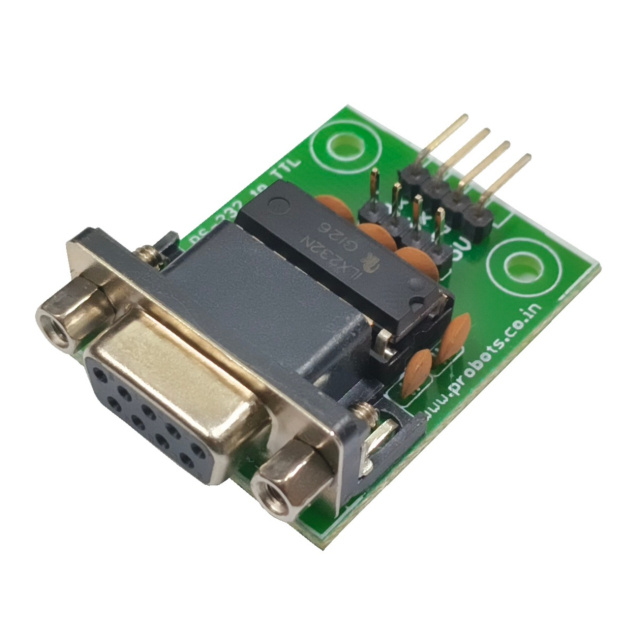
Q: Can this handle RS232 voltage levels? No! This is a TTL (Transistor-Transistor Logic) converter, operating at 0V to 5V (or 3.3V). Standard RS232 operates at -12V to +12V. Plugging this directly into an old 9-pin RS232 port will destroy the module. You would need a MAX232 chip in between.
Q: How much power can the VCC pin supply? If set to 5V, the VCC pin draws directly from your computer's USB port, typically safely providing up to 400-500mA. However, if set to 3.3V, the power comes from the internal LDO regulator of the FT232 chip, which maxes out at around 50mA. Do not power heavy loads (like an ESP8266 transmitting Wi-Fi) directly from the 3.3V VCC pin.
Q: My computer says "Device Not Recognized" or fails to open the COM port. What's wrong? First, verify you are using a data-sync USB cable. Second, in the past, FTDI released drivers that temporarily disabled cloned/counterfeit chips. If you suspect driver issues, rolling back to an older FTDI driver version (e.g., v2.12.00) in Windows Device Manager often resolves communication errors.
Q: What do the onboard LEDs mean? The red LED near the USB port usually indicates power. The TX LED flashes when the module is transmitting data to the target board. The RX LED flashes when the module is receiving data back from the target board.
Q: What is the maximum baud rate this module supports? The FT232RL chip supports asynchronous serial baud rates up to 3 Mbps.
Q: Can I leave the 3.3V/5V jumper off completely? No. If you remove the jumper cap, the TX/RX logic pins and the VCC pin will not receive power, and the module will not be able to communicate with your target device.
Q: How do I wire this to an Arduino Pro Mini? The Arduino Pro Mini has a 6-pin programming header that exactly matches the FTDI module. Simply ensure the DTR pin on the FTDI aligns with the DTR (or GRN) pin on the Pro Mini, and plug them together (or use straight jumper wires).
Q: What does TTL mean? TTL stands for Transistor-Transistor Logic. In modern embedded electronics, it simply signifies that the digital signals operate at low logic voltages (typically 0V for LOW and either 3.3V or 5V for HIGH).
Q: Does this work with a Raspberry Pi? Yes, you can plug this into the USB port of a Raspberry Pi to give the Pi an extra hardware serial port, or you can connect it to the Pi's GPIO UART pins (ensure the FTDI is set to 3.3V!) to log into the Pi's command line directly from a Windows PC without a monitor or SSH.
Q: Is it safe to power the FTDI module via USB while the target microcontroller is powered by a battery? Yes, but you MUST connect the GND pin of the FTDI to the GND of your target board to establish a common voltage reference. You can leave the VCC pin disconnected so they don't fight over powering the circuit.
Probots sells every Electronics Part for your next Project. You can order 10,000+ Electronic Parts Online - Arduino, Raspberry Pi, NodeMCU Development Boards, Sensors, Motors, Motor Drivers, SMPS, Plastic Enclosures etc in India directly on probots.co.in
We delivery electronics components and parts throughout India using standard couriers like Bluedart, Delhivery & India Post.
For order related queries contact -
This item is covered by a warranty of 7 days from the date of delivery, against confirmed manufacturing defects only, as verified by Probots' own testing and investigation. In case of a confirmed defect, we will replace the item — a refund is issued only if a replacement can't be supplied (e.g. discontinued or out of stock). Transit damage or a wrong item received must be reported within 3 days of delivery.
If the product shows signs of misuse, tampering, physical damage, static discharge, liquid or fire damage, use of unapproved chemicals, or has been soldered or physically altered in any way.
China
Probots sells every Electronics Part for your next Project. You can order 10,000+ Electronic Parts Online - Arduino, Raspberry Pi, NodeMCU Development Boards, Sensors, Motors, Motor Drivers, SMPS, Plastic Enclosures etc in India directly on probots.co.in
We offer specialized services for Bulk, Wholesale & B2B Customers like discounted prices, additional shipping options, customised products, etc . Customer with large quantity & regular orders qualify for the specialised discounted rates.
We also offer dedicated sales team to assist you with the order process by providing sales quotations, PI, technical support for choosing products, etc.
Note: Business Orders are processed manually and usually take 1-3 days to process compared to placing the order directly on our website. Please plan your purchases accordingly.
Need Help?
For bulk enquiries contact us by -
Probots Electronics is highly regarded for its highly skilled team and knowledgeable staff who provide expert guidance to ensure customers select the right components for their technical projects. The business maintains a strong reputation for prompt service and reliable support, with many clients praising their quick response times and genuine commitment to customer satisfaction.


A very great place for electronics Such a well maintained shop... Felt good shopping here


Nice

For new developments kit available and they will support till working, and I suggest this place strongly


This place has all the electronic parts students will ever need, staff is friendly and the place is organised.


It was a really nice experience! I was happy to find such a wide range of robotics kits for kids, suitable for different age groups and learning levels.

Excellent experience




Good stuff

Buyed them. But no bargain. Helpful staff.


Available all children school project spears parts like electronics


It was good experience




Staff is very patient and helpful

One of the best place for electronics you will get everything you want! With the best and orginal quality

Very helpful staff and the best place to buy components for projects

Wonderful store with expert service and technically strong people.

Prompt delivery, excellent technical support


Large inventory of electronic components and parts. Well trained service personnel and technicians who can quickly identify and rectify product defect if any. They are a reliable and trustworthy online stores.

A very great place for electronics Such a well maintained shop... Felt good shopping here
Nice
For new developments kit available and they will support till working, and I suggest this place strongly
This place has all the electronic parts students will ever need, staff is friendly and the place is organised.
It was a really nice experience! I was happy to find such a wide range of robotics kits for kids, suitable for different age groups and learning levels.
Excellent experience
Good stuff
Buyed them. But no bargain. Helpful staff.
Available all children school project spears parts like electronics
It was good experience
Staff is very patient and helpful
One of the best place for electronics you will get everything you want! With the best and orginal quality
Very helpful staff and the best place to buy components for projects
Wonderful store with expert service and technically strong people.
Prompt delivery, excellent technical support
Large inventory of electronic components and parts. Well trained service personnel and technicians who can quickly identify and rectify product defect if any. They are a reliable and trustworthy online stores.
● 20 min readVol. 56 | The Heavyweight DC Drivetrain Duel Reliability isn’t optional when you’re designing actuators that need to move actual steel or
Read Article → ● 13 min read
Workbench Vol. 49 🚀 The Project Trifecta: 3 Builds to Start Today We don’t just stock parts; we curate ecosystems. This week’s arrivals are desi
Read Article → ● 18 min read
Vol. 59 | The Battle of the Bite-Sized Boards Picture a project that needs full Linux, networking, and GPIO—but has almost no room for a conventional
Read Article →