












 ● 20 min read
Showdown: RS550 12V DC 8000 vs RS-555 12V DC 6000 RPM DC Motor
Vol. 56 | The Heavyweight DC Drivetrain Duel Reliability isn’t optional when you’re designing actuators that need to move actual steel or
Read Article →
| Bulk Pricing | ||
|---|---|---|
| QTY | Unit Price(Inlc. GST) | |
| 2+ | ₹1,273.02 ₹ 1078.83 + 194.19 GST | |
| 4+ | ₹1,260.03 ₹ 1067.82 + 192.21 GST | |
| 6+ | ₹1,247.04 ₹ 1056.81 + 190.23 GST | |
| 10+ | ₹1,221.06 ₹ 1034.8 + 186.26 GST | |
Control industrial 0-10V analog equipment directly from your Arduino with the GP8101S module. It converts a standard PWM signal into a precise analog voltage, featuring an onboard switch to easily select between 0-5V and 0-10V output ranges.
Bridging Digital and Analog Worlds Microcontrollers like the Arduino are strictly digital devices; they output either 0V or 5V. However, many pieces of industrial equipment—such as commercial light dimmers, motor speed controllers (VFDs), and proportional valves—require a smooth, sliding analog voltage to operate (typically 0 to 10 Volts). The GP8101S Module solves this incompatibility. It takes the rapidly pulsing digital PWM signal from your microcontroller, interprets the duty cycle, and outputs a perfectly smooth, true analog voltage corresponding to that percentage.
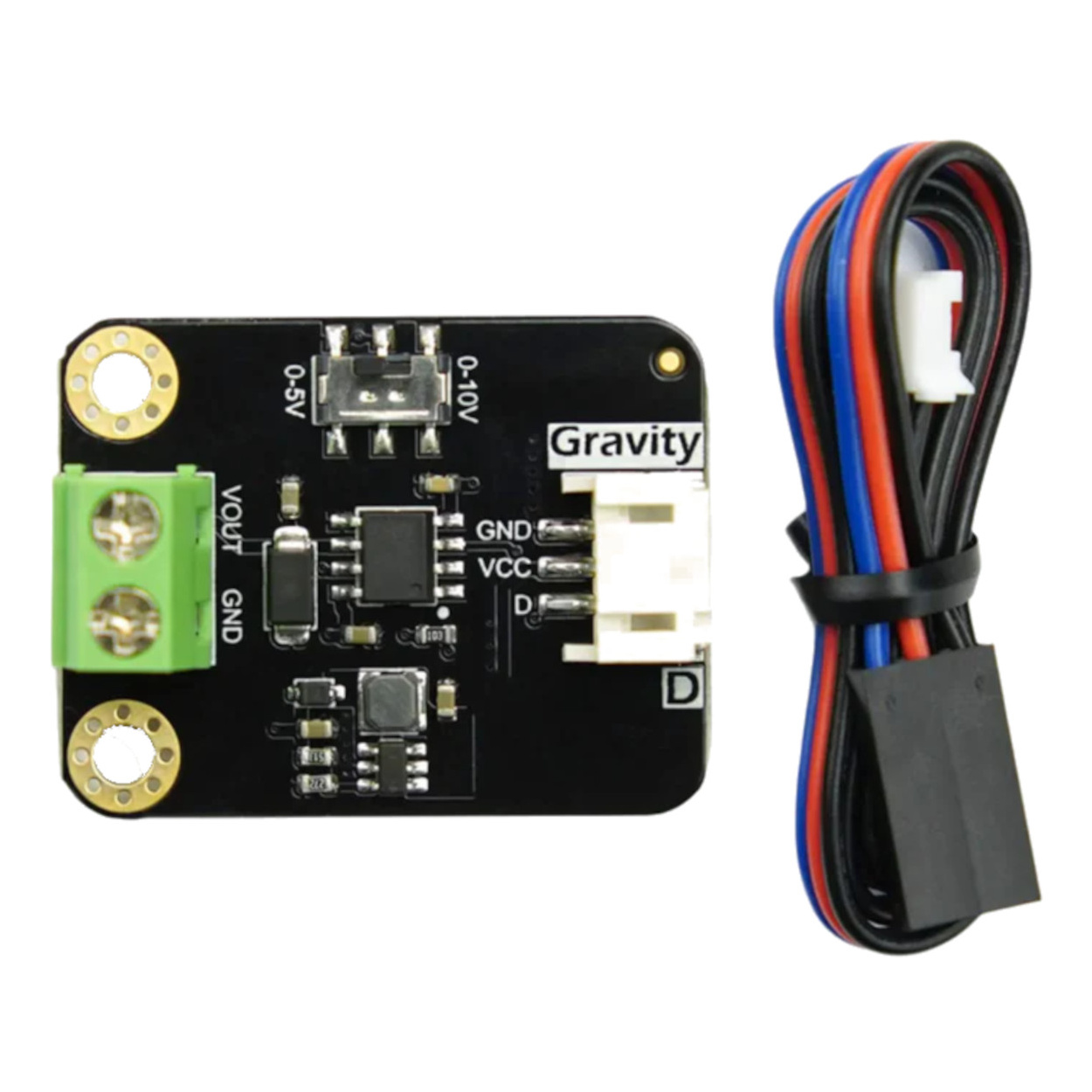
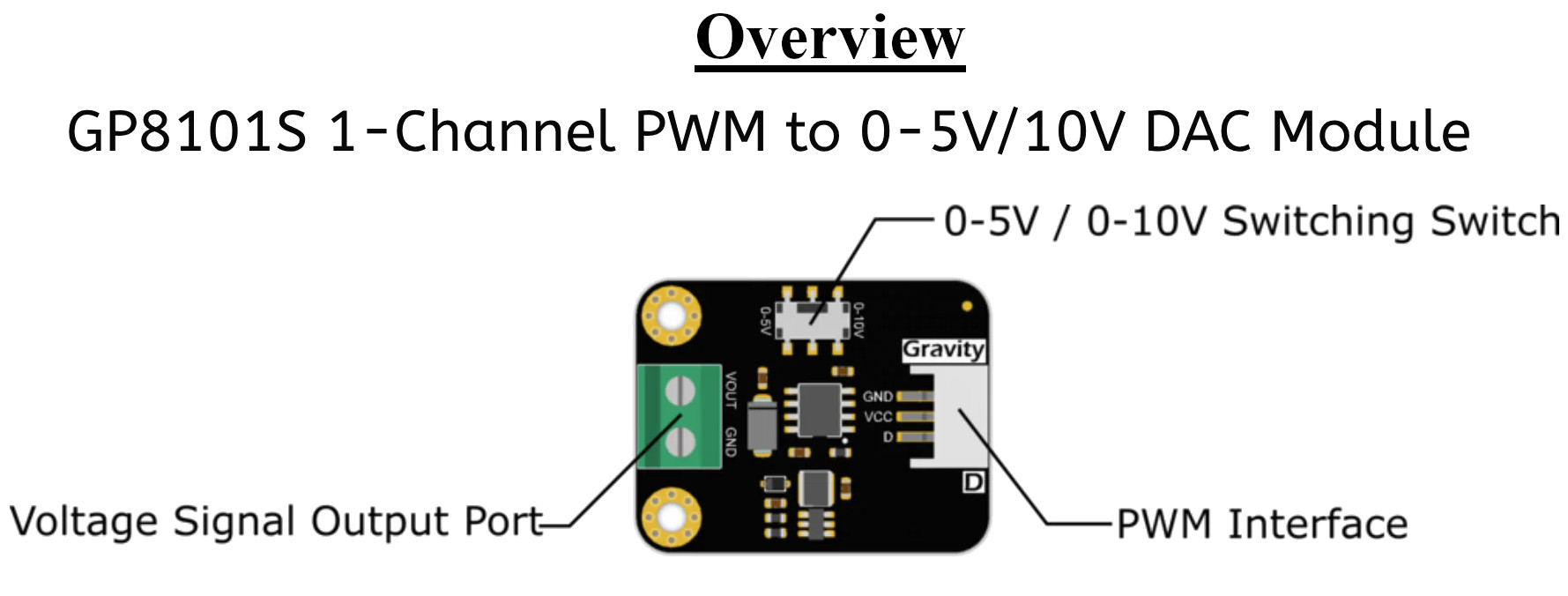
Selectable 0-5V or 0-10V Output Flexibility is built directly into the hardware. At the top of the module is a tiny sliding switch. By simply moving this switch, you can tell the internal DAC chip to output a maximum voltage of either 5 Volts or 10 Volts.
If set to 10V: A 50% PWM duty cycle from your Arduino will output exactly 5.0V from the green terminal block. A 100% duty cycle will output 10.0V.
If set to 5V: A 50% PWM duty cycle will output exactly 2.5V.
Plug-and-Play Integration Designed as part of the "Gravity" ecosystem, this module is incredibly easy to wire. The input side features a keyed 3-pin JST connector (Signal, VCC, GND) that plugs directly into a microcontroller expansion shield using the included cable. The output side features a robust green screw terminal block marked VOUT and GND, allowing you to quickly secure the wires leading to your heavy-duty industrial equipment without needing a soldering iron.
Core Chip: GP8101S
Module Function: Digital PWM to Analog Voltage (DAC)
Operating Voltage (VCC): 3.3V to 5V DC
Input Signal: Standard PWM (Pulse Width Modulation)
Output Range (Selectable): 0-5V DC OR 0-10V DC
Input Interface: 3-Pin JST (Gravity Standard)
Output Interface: 2-Pin Screw Terminal Block (VOUT, GND)
Dimensions: 35mm x 27mm
CNC Spindle Control: Converting the PWM speed signal from a GRBL controller board into the 0-10V analog signal required by a commercial VFD (Variable Frequency Drive) to control the RPM of a large routing spindle.
Industrial Lighting: Interfacing a 3.3V ESP32 smart home controller with commercial 0-10V dimmable LED drivers in a warehouse or office.
Proportional Fluid Valves: Using an Arduino to precisely open and close a 0-5V analog proportional valve in an automated hydroponics or brewing setup.
Unlock New Capabilities (Project Evolution)
The Smart Automated Laser Cutter: Evolve your workshop! Many DIY laser cutters use simple relays to turn the laser on and off. By upgrading your machine's controller board to output a PWM signal, and running that signal through the GP8101S set to 0-5V, you can feed that analog voltage directly into your laser's power supply. This allows your CNC software to dynamically adjust the laser's power intensity on the fly, enabling you to engrave highly detailed, shaded grayscale photos rather than just solid black-and-white silhouettes!
1 x GP8101S PWM to 0-5V/10V Analog Voltage Module
1 x 3-Pin JST Connecting Cable

What does this module actually do? It translates a digital, rapidly pulsing signal (PWM) from a microcontroller into a smooth, steady analog voltage.
Why do I need a 0-10V signal? Many commercial and industrial devices, such as motor Variable Frequency Drives (VFDs) and heavy-duty light dimmers, do not understand digital code. They require a physical 0 to 10 Volt sliding scale to know how fast or bright to run.
How do I choose between 0-5V and 0-10V output? There is a small, physical sliding switch on the top edge of the board. Simply slide it to the voltage range you require.
Do I need a separate 12V power supply to generate 10V? Yes. While the module's logic chip runs on 5V (VCC), the module uses an internal boost converter to generate the 10V output. Ensure your main power source can handle the slight extra current draw.
How do I wire the input? Use the included 3-pin cable. Plug it into the white connector marked "Gravity". Connect the other ends to your Arduino: Black to Ground, Red to 5V, and Blue (or Green/Yellow) to a PWM-capable digital pin.
How do I wire the output? Strip the wires coming from your industrial equipment, insert them into the green screw terminal block, and tighten the screws. The top port is VOUT (Voltage Out), and the bottom is GND (Ground).
What happens if I send a 0% PWM signal (always OFF)? The module will output 0.0 Volts.
What happens if I send a 100% PWM signal (always ON)? The module will output the maximum voltage you selected on the switch (either 5.0V or 10.0V).
What happens if I send a 25% PWM signal while set to 0-10V? The module will output exactly 2.5 Volts (25% of 10V).
Can I use this with a 3.3V microcontroller like an ESP32 or Raspberry Pi? Yes, the PWM input pin is tolerant of 3.3V logic signals, and it will still accurately convert the duty cycle to the selected output voltage.
Does the frequency of the PWM signal matter? The GP8101S chip is designed to accept a wide range of standard PWM frequencies (typically 1kHz to 10kHz), making it compatible with the default analogWrite() frequencies of most Arduino boards.
Can I use this module backward to read an analog signal into a digital pin? No. This is strictly a Digital-to-Analog Converter (DAC). It only flows one way. If you need to read analog sensors, use your Arduino's built-in ADC (Analog-to-Digital Converter) pins.
Is the output voltage perfectly stable? Yes, the internal circuitry filters the pulsing PWM signal into a clean, smooth DC voltage, which is critical for sensitive VFD controllers that might otherwise stutter on a "dirty" signal.
How much current can the output terminals provide? This is a signal module, not a power supply. The analog output is meant to send a voltage signal to a controller (which draws mere milliamps). It cannot directly power a motor or a lightbulb.
What are the overall dimensions of the board? The PCB measures 35mm long by 27mm wide.
How do I mount it? The board features four gold-plated mounting holes (one in each corner) that accept standard M3 screws or nylon standoffs.
What is the brand of this module? This module is manufactured by DFRobot, specifically as part of their plug-and-play "Gravity" series.
Can I use the analogWrite() command in Arduino IDE with this? Yes! In Arduino, analogWrite(pin, 127) outputs a 50% PWM duty cycle. If the switch is set to 10V, the green terminal will output 5V.
What happens if I change the switch while the module is powered on? It is highly recommended to turn off the power to the module before flipping the 5V/10V switch to prevent sudden voltage spikes from damaging your connected industrial equipment.
Why are there extra solder pads on the back? The back of the board shows the solder points for the through-hole components (the terminal block and JST connector) and testing points used during manufacturing. You do not need to solder anything on the back.
Probots sells every Electronics Part for your next Project. You can order 10,000+ Electronic Parts Online - Arduino, Raspberry Pi, NodeMCU Development Boards, Sensors, Motors, Motor Drivers, SMPS, Plastic Enclosures etc in India directly on probots.co.in
We delivery electronics components and parts throughout India using standard couriers like Bluedart, Delhivery & India Post.
For order related queries contact -
This item is covered by a warranty of 7 days from the date of delivery, against confirmed manufacturing defects only, as verified by Probots' own testing and investigation. In case of a confirmed defect, we will replace the item — a refund is issued only if a replacement can't be supplied (e.g. discontinued or out of stock). Transit damage or a wrong item received must be reported within 3 days of delivery.
If the product shows signs of misuse, tampering, physical damage, static discharge, liquid or fire damage, use of unapproved chemicals, or has been soldered or physically altered in any way.
China
Probots sells every Electronics Part for your next Project. You can order 10,000+ Electronic Parts Online - Arduino, Raspberry Pi, NodeMCU Development Boards, Sensors, Motors, Motor Drivers, SMPS, Plastic Enclosures etc in India directly on probots.co.in
We offer specialized services for Bulk, Wholesale & B2B Customers like discounted prices, additional shipping options, customised products, etc . Customer with large quantity & regular orders qualify for the specialised discounted rates.
We also offer dedicated sales team to assist you with the order process by providing sales quotations, PI, technical support for choosing products, etc.
Note: Business Orders are processed manually and usually take 1-3 days to process compared to placing the order directly on our website. Please plan your purchases accordingly.
Need Help?
For bulk enquiries contact us by -


Probots Electronics is highly regarded for its highly skilled team and knowledgeable staff who provide expert guidance to ensure customers select the right components for their technical projects. The business maintains a strong reputation for prompt service and reliable support, with many clients praising their quick response times and genuine commitment to customer satisfaction.


A very great place for electronics Such a well maintained shop... Felt good shopping here


Nice

For new developments kit available and they will support till working, and I suggest this place strongly


This place has all the electronic parts students will ever need, staff is friendly and the place is organised.


It was a really nice experience! I was happy to find such a wide range of robotics kits for kids, suitable for different age groups and learning levels.

Excellent experience




Good stuff

Buyed them. But no bargain. Helpful staff.


Available all children school project spears parts like electronics


It was good experience




Staff is very patient and helpful

One of the best place for electronics you will get everything you want! With the best and orginal quality

Very helpful staff and the best place to buy components for projects

Wonderful store with expert service and technically strong people.

Prompt delivery, excellent technical support


Large inventory of electronic components and parts. Well trained service personnel and technicians who can quickly identify and rectify product defect if any. They are a reliable and trustworthy online stores.

A very great place for electronics Such a well maintained shop... Felt good shopping here
Nice
For new developments kit available and they will support till working, and I suggest this place strongly
This place has all the electronic parts students will ever need, staff is friendly and the place is organised.
It was a really nice experience! I was happy to find such a wide range of robotics kits for kids, suitable for different age groups and learning levels.
Excellent experience
Good stuff
Buyed them. But no bargain. Helpful staff.
Available all children school project spears parts like electronics
It was good experience
Staff is very patient and helpful
One of the best place for electronics you will get everything you want! With the best and orginal quality
Very helpful staff and the best place to buy components for projects
Wonderful store with expert service and technically strong people.
Prompt delivery, excellent technical support
Large inventory of electronic components and parts. Well trained service personnel and technicians who can quickly identify and rectify product defect if any. They are a reliable and trustworthy online stores.
● 20 min readVol. 56 | The Heavyweight DC Drivetrain Duel Reliability isn’t optional when you’re designing actuators that need to move actual steel or
Read Article → ● 13 min read
Workbench Vol. 49 🚀 The Project Trifecta: 3 Builds to Start Today We don’t just stock parts; we curate ecosystems. This week’s arrivals are desi
Read Article → ● 18 min read
Vol. 59 | The Battle of the Bite-Sized Boards Picture a project that needs full Linux, networking, and GPIO—but has almost no room for a conventional
Read Article →