








 ● 20 min read
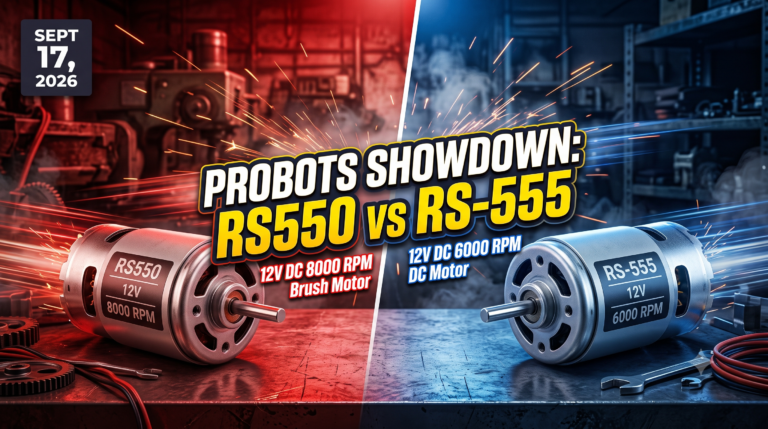
Showdown: RS550 12V DC 8000 vs RS-555 12V DC 6000 RPM DC Motor
Vol. 56 | The Heavyweight DC Drivetrain Duel Reliability isn’t optional when you’re designing actuators that need to move actual steel or
Read Article →
Imagine if your car's airbag took "just one second" to deploy. Or if your medical heart monitor "buffered" for a moment. In the real world, some products don't get a second chance. They must work instantly, every single time, without fail.
This is the high-stakes world of real-time engineering. It’s not just about being fast—it's about being predictable. This is a discipline of hard deadlines, formal task scheduling, and microamp-level power management, all of which are impossible to achieve with standard Linux/Bitbanging software. Our service is the essential discipline of engineering this robust, reliable, and deterministic foundation for your product's mission-critical success.
An RTOS (Real-Time Operating System) is a specialized, lightweight operating system designed to execute tasks in a precise, predictable, and timely manner, making it the non-negotiable foundation for any reliable, safety-critical, or battery-powered embedded product.
Our RTOS & Real-Time Systems service is the expert-level process of architecting and building reliable software for microcontrollers (MCUs). We are not just application coders; we are low-level systems engineers. This RTOS service is a core pillar of our full end-to-end hardware design services, where we architect the entire product from the MCU and schematic up to the cloud. Our core competency is in selecting the right RTOS for your job and building a clean, scalable, and provably reliable architecture on top.
We are masters of low-power optimization, task management (mutexes, semaphores), and clean Hardware Abstraction Layer (HAL) design. This solves the critical business problems of missed real-time deadlines, high "jitter," unmanageable "spaghetti code" (bare-metal super-loops), and high-power consumption that drains battery life.
Our expertise is built on deep, hardware-level experience with the MCUs that power these products. We are not limited to one brand; we are masters of the entire modern MCU landscape:
RTOS Platforms: We have production-level expertise in FreeRTOS (the industry standard), Zephyr (for complex, connected, and secure IoT), Azure RTOS / ThreadX (Microsoft/Eclipse), Mbed OS (Arm), NuttX, and RIOT.
MCU Hardware:


Any team can download FreeRTOS. Our advantage is an AI Co-Pilot trained on our most valuable asset: a proprietary database of real-world task-timing benchmarks, power consumption profiles, and stack usage data from hundreds of deployed MCU projects.
The Tangible Payoff:
[Visual Aid Suggestion: An image of a data-rich AI analytics dashboard showing task timing and CPU load.]

Our metrics are our proof: we have successfully architected and deployed over 100+ unique real-time applications, with our firmware currently powering over 1,000,000+ reliable devices in the field.
Case Study: The "Jittery" Industrial Motor Controller

We build all code to be robust and certifiable. Our development process adheres to strict MISRA C coding standards, and we have experience building systems compliant with safety-critical software standards like IEC 62304 (Medical) and ISO 26262 (Automotive).
Our Engineering Philosophy: In a real-time system, "almost on time" is "always wrong."
When to Choose RTOS vs. Custom Linux: This is a critical architectural decision. This RTOS service is the right choice when your primary drivers are cost, power, and deterministic reliability. It is perfect for battery-powered wearables, high-speed motor controllers, and safety-critical sensors. Our [Custom Embedded Linux Development] service is the right choice when your product needs a "rich" experience, like a complex graphical touchscreen, high-speed networking, or the ability to run multiple, large applications (like our [Edge AI & Machine Learning Deployment] services). We will always guide you to the right architecture for your goal.
We engage with clients at any stage, providing precisely the value they need:

A modern MCU doesn't just run a motor; it's a connected data source. Your RTOS device is the "T" in IoT, but its data is useless if it's trapped on the device. A critical part of our RTOS service is designing the data pipeline from the device to your enterprise systems.
We don't just build the RTOS; we build the data contract (the "API") for the device. We co-design this with your cloud team (or our own [Cloud Backend & IoT Platform] team) from day one. We ensure your RTOS-based device speaks the right language, whether it's publishing lightweight MQTT packets to an IoT hub or sending data over a custom BLE (Bluetooth Low Energy) profile.
This ensures the sensor data from your RTOS-powered device is clean, efficient, and ready to be consumed by your business analytics platforms (like Power BI or Salesforce), enabling real-time dashboards, predictive maintenance alerts, and seamless business integration.

This is a critical strategic decision. Your primary alternatives are a vendor's "black box" SDK or a DIY bare-metal approach.
The Generic/Vendor Trap (The "Vendor SDK" Trap): This is the "easy" trap. You pull down the vendor's SDK (like the ST CubeIDE or NXP MCUXpresso) and build on top of their 1,000+ HAL functions. You are now stuck in their black box. Their code is bloated, power-hungry, and when you find a bug, you can't fix it. You are not in control of your own product; the silicon vendor is.
The In-House Labyrinth (The "Bare-Metal Super-Loop" Trap): This is the #1 reason reliable devices fail. Your team builds a "simple" while(1) loop. It works perfectly for one feature. Then you add Bluetooth. Now your main loop is blocked, and your sensor readings are missed. You add a second feature, and now you have a 5,000-line main.c file, timing is broken, and a simple bug fix takes a week of debugging. You have no scalability and no reliability.
The "Hidden" Engineering Tasks: The real work in an RTOS is not just "using" it. It's the deep, expert-level tasks:
The Expert Partner Solution: We are your expert, outsourced RTOS team. We have already mastered this "In-House Labyrinth." We deliver a clean, event-driven, and provably-reliable architecture, allowing your team to focus on what they do best: building your proprietary application logic.

Phase 1 (No-Cost): Architecture Workshop. We start with a free consultation to review your hardware, real-time deadlines, power budget, and safety/security requirements.
Phase 2 (Commercials): Formal Proposal & RTOS Selection. We provide a detailed proposal, recommending the best RTOS (FreeRTOS, Zephyr, etc.) and MCU for your project, along with a firm timeline and quote.
Phase 3 (Execution): Architecture & HAL Development. We architect the complete system: all tasks, queues, semaphores, and mutexes. We then write a clean, efficient Hardware Abstraction Layer (HAL) for your specific MCU.
Phase 4 (Execution): Application Development & Optimization. We build your core application logic on top of the RTOS. We then perform deep profiling, optimizing CPU load, stack/heap usage, and low-power sleep modes to meet your performance and battery life targets.
Phase 5 (Handoff & Support): Full Handoff & Team Integration. We deliver the complete, fully-documented source code. Our "white-glove" handoff includes setting up your team's development environment, including the cross-compilation toolchain (GCC) and on-chip debugging (GDB/J-Link/ST-Link). We then transition to long-term support.
[Visual Aid Suggestion: A clean flowchart visualizing the RTOS task architecture.]

FreeRTOS vs. Zephyr? Which is right for me?
We are experts in both. FreeRTOS is the industry standard—it's lightweight, incredibly stable, and has a tiny memory footprint, making it perfect for deeply embedded, focused tasks. Zephyr is a newer, more powerful RTOS with a rich set of built-in features (like networking, BLE, and security). We often recommend Zephyr for more complex, connected IoT products that need more features than FreeRTOS can easily provide.
Why not just use a "bare-metal" super-loop? It's simpler.
A bare-metal while(1) loop is "simple" for one or two tasks. It is impossible to manage for a real product. As you add features (e.g., a BLE stack, a new sensor), your timing breaks, your code becomes an unmaintainable "spaghetti" mess, and you cannot reliably guarantee that your critical tasks will run on time. An RTOS provides a clean, scalable, and provably reliable architecture.
What is "deterministic," and why does it matter?
Determinism means that a task (e.g., "stop the motor") is guaranteed to execute within a precise, predictable time window (e.g., 50 milliseconds), every single time. A non-real-time system (like Linux or a bare-metal loop) might take 40ms one time and 400ms the next. For a safety-critical device, that 400ms delay is a catastrophic failure.
How do you achieve ultra-low-power (<10uA) sleep current?
This is a system-level task. We use RTOS features like "tickless idle" (so the CPU isn't waking up every millisecond). Then, we meticulously write the HAL to power down every unused peripheral (like ADCs, timers, or UARTs), shut off clocks, and put the MCU into its deepest sleep state (e.g., STOP2 on an STM32), waking only on a specific hardware interrupt.
What is "priority inversion," and how do you prevent it?
This is a classic RTOS failure where a high-priority task gets stuck waiting for a resource (like a data buffer) that is being held by a low-priority task. We prevent this by designing a clean architecture with priority inheritance mutexes, which temporarily "boost" the low-priority task's priority so it can finish its work and release the resource, unblocking the critical task.
Do you write MISRA C compliant code?
Yes. For any safety-critical (medical, automotive, industrial) project, we enforce MISRA C compliance. This set of strict rules prevents common C programming errors (like ambiguous code or undefined behavior) and is a foundational requirement for building certifiable, high-reliability software.
What are semaphores, mutexes, and queues?
These are the primary tools an RTOS provides for "task communication":
Queues: Used to send data (like a sensor reading) from one task to another, safely.
Semaphores: Used for signaling. A task can "wait" on a semaphore until an interrupt (like "data ready") "gives" it, allowing it to run.
Mutexes: Used to protect a shared resource (like a log file). A task must "take" the mutex to write to the file, ensuring no other task can interrupt it and corrupt the data.
What's your debugging and toolchain expertise?
We are experts with the ARM GCC cross-compilation toolchain. For debugging, we are masters of on-chip hardware debuggers, using Segger J-Link or ST-Link to connect directly to the MCU. This allows us to use GDB to set breakpoints, inspect live memory, and step through code on the actual hardware, which is essential for solving complex, real-time bugs.
What does your "white-glove handoff" include?
Our project isn't done until your team is empowered. We deliver the full, clean, documented source code. Then, we schedule remote sessions with your engineers to set up their entire cross-compilation and debugging environment (VS Code, GCC, J-Link/GDB) so they are compiling and debugging the project on their own machines, just as we do.
How do you manage memory (stack/heap)?
We avoid dynamic memory (malloc()) wherever possible, as it's non-deterministic and leads to fragmentation. We use static allocation for all tasks, buffers, and queues. We then use the RTOS's tools (like FreeRTOS's uxTaskGetStackHighWaterMark) to profile the exact stack usage of every task, ensuring we never have a stack overflow.
How do you handle connectivity and enterprise data integration?
This is a core part of our service. Our RTOS team co-designs the data pipeline with our [Cloud Backend & IoT Platform] team. We build lightweight, efficient MQTT or CoAP clients that run as tasks on the RTOS. We define a clean data model (often with Protobuf) that ensures the data from your MCU is sent securely and efficiently to your cloud backend (AWS/Azure) and is ready for your enterprise systems (like Power BI or Salesforce).
What is a "hard" vs. "soft" real-time system?
A hard real-time system cannot miss a deadline, ever (e.g., an airbag controller). A soft real-time system can tolerate an occasional missed deadline, though performance will degrade (e.g., a video-streaming device). We architect your system to meet the correct requirement, ensuring critical tasks are always hard real-time.
How do you handle memory management on an MCU?
This is a critical task. We rely on the RTOS's static allocation where possible and use its built-in, deterministic heap management (like FreeRTOS's heap_4.c) to prevent memory fragmentation. A key part of our process is profiling the stack usage of every task to ensure we never have a stack overflow, which is the most common and difficult-to-debug RTOS crash.
What's your experience with industrial protocols like Modbus or CAN?
This is one of our specialties. We have extensive experience building robust protocol stacks (e.g., Modbus RTU/TCP, CANopen) as dedicated, self-contained tasks within an RTOS. This isolates the complex protocol logic from your main application, leading to a much more stable and maintainable system.
How do you test real-time code?
We use a multi-level approach:
Unit Testing: We test "pure" logic functions (like a data-parsing algorithm) on a host PC.
Hardware-in-the-Loop (HIL): We use test harnesses to feed real electrical signals into the MCU, simulating the real world and verifying the code's response.
Task-Level Profiling: We use tools (like Percepio Tracealyzer or Segger SystemView) to visually trace RTOS execution and prove that tasks are meeting their deadlines.
What is a Hardware Abstraction Layer (HAL)?
A HAL is a layer of software that separates your application from the specific hardware. Your application code will call a simple function like set_led(true). The HAL is the code that "knows" that on an STM32 this means writing to the GPIOA->BSRR register, while on an nRF52 it's a different register. This makes your application portable and much easier to test and maintain.
What is a "Board Support Package" (BSP) for an MCU?
A BSP is the "glue" that makes an RTOS work on your specific board. It contains the low-level startup code (setting clocks, initializing memory), the HAL, and any drivers for the specific peripherals on your custom board (like an external sensor or flash memory). We deliver this as a key part of our service.
Do you support Over-the-Air (OTA) updates on MCUs?
Yes, this is essential for any modern connected device. We are experts in implementing robust, secure bootloaders and OTA clients (e.g., using FreeRTOS's OTA library or Zephyr's mcuboot). We design a dual-bank flash system to ensure that an update can fail safely without "bricking" the device.
What's your experience with Bluetooth (BLE) stacks?
We are deeply experienced with the two main stacks. We are experts in the Zephyr BLE stack (which is powerful and full-featured) and the Nordic SoftDevice (which is a pre-compiled, certified binary). We design your application to run alongside the stack, managing the complex, real-time demands of the BLE protocol.
How do you handle security on an MCU?
This is critical. We leverage modern hardware features like ARM TrustZone-M (on chips like the STM32L5 or nRF53) to create a secure, isolated "world" for critical functions (like key storage). We also implement secure boot (so the device only runs firmware you signed), secure key storage, and encrypted communication.
Probots Electronics is highly regarded for its highly skilled team and knowledgeable staff who provide expert guidance to ensure customers select the right components for their technical projects. The business maintains a strong reputation for prompt service and reliable support, with many clients praising their quick response times and genuine commitment to customer satisfaction.


A very great place for electronics Such a well maintained shop... Felt good shopping here


Nice

For new developments kit available and they will support till working, and I suggest this place strongly


This place has all the electronic parts students will ever need, staff is friendly and the place is organised.


It was a really nice experience! I was happy to find such a wide range of robotics kits for kids, suitable for different age groups and learning levels.

Excellent experience




Good stuff

Buyed them. But no bargain. Helpful staff.


Available all children school project spears parts like electronics


It was good experience




Staff is very patient and helpful

One of the best place for electronics you will get everything you want! With the best and orginal quality

Very helpful staff and the best place to buy components for projects

Wonderful store with expert service and technically strong people.

Prompt delivery, excellent technical support


Large inventory of electronic components and parts. Well trained service personnel and technicians who can quickly identify and rectify product defect if any. They are a reliable and trustworthy online stores.

A very great place for electronics Such a well maintained shop... Felt good shopping here
Nice
For new developments kit available and they will support till working, and I suggest this place strongly
This place has all the electronic parts students will ever need, staff is friendly and the place is organised.
It was a really nice experience! I was happy to find such a wide range of robotics kits for kids, suitable for different age groups and learning levels.
Excellent experience
Good stuff
Buyed them. But no bargain. Helpful staff.
Available all children school project spears parts like electronics
It was good experience
Staff is very patient and helpful
One of the best place for electronics you will get everything you want! With the best and orginal quality
Very helpful staff and the best place to buy components for projects
Wonderful store with expert service and technically strong people.
Prompt delivery, excellent technical support
Large inventory of electronic components and parts. Well trained service personnel and technicians who can quickly identify and rectify product defect if any. They are a reliable and trustworthy online stores.
● 20 min readVol. 56 | The Heavyweight DC Drivetrain Duel Reliability isn’t optional when you’re designing actuators that need to move actual steel or
Read Article →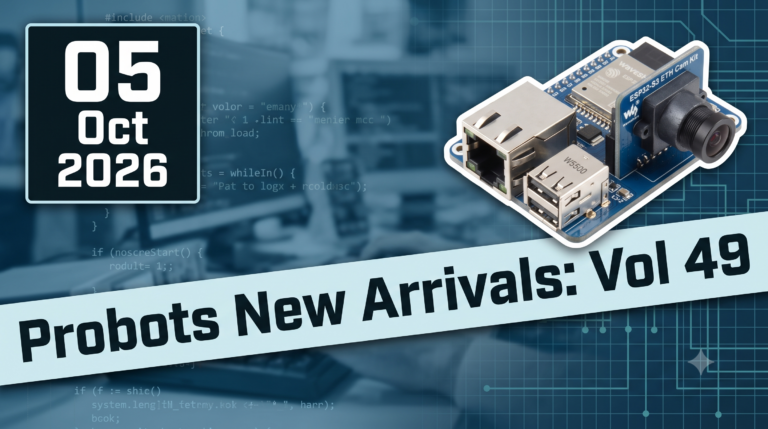 ● 13 min read
Workbench Vol. 49 🚀 The Project Trifecta: 3 Builds to Start Today We don’t just stock parts; we curate ecosystems. This week’s arrivals are desi
Read Article → ● 18 min read
Vol. 59 | The Battle of the Bite-Sized Boards Picture a project that needs full Linux, networking, and GPIO—but has almost no room for a conventional
Read Article →