









 ● 20 min read
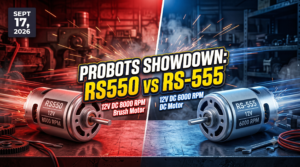
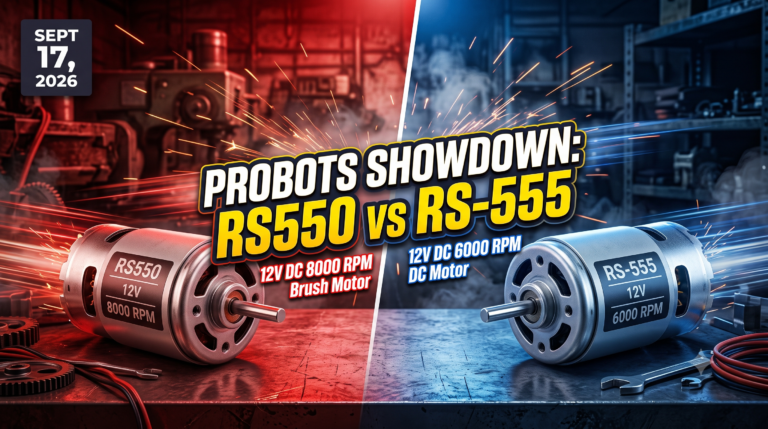
Showdown: RS550 12V DC 8000 vs RS-555 12V DC 6000 RPM DC Motor
Vol. 56 | The Heavyweight DC Drivetrain Duel Reliability isn’t optional when you’re designing actuators that need to move actual steel or
Read Article →
When microseconds matter, software is too slow. In the world of high-frequency trading, radar signal processing, and 8K video streaming, standard processors (CPUs/GPUs) hit a wall of latency and non-determinism. FPGA Design is the discipline of building custom "silicon" without the $5M fabrication cost. It allows you to engineer massive parallel processing power that executes logic in nanoseconds, not milliseconds.
Our service provides the expert-level architecture and HDL coding required to harness this immense power. We don't just write Verilog; we engineer high-performance compute engines that solve problems physics otherwise wouldn't allow. We bridge the gap between software flexibility and hardware speed, ensuring your product dominates its market in performance.
Our FPGA Design & HDL Development service is the expert-level process of architecting, coding, and verifying custom digital logic. We are not just embedded engineers; we are Digital Logic Architects. Our core competency is in translating complex algorithms into synthesized hardware using Verilog, SystemVerilog, and VHDL. We master the entire flow: from RTL Design and Testbench Verification (UVM) to Timing Closure and on-hardware debugging.
We go beyond the bitstream. An FPGA is useless without the hardware around it. We specialize in integrating the FPGA into production-grade hardware. This includes:
We specialize in advanced Digital Signal Processing (DSP) across domains:

We solve the critical business problems of latency bottlenecks, throughput limits, and obsolescence. We can replace an End-of-Life (EOL) ASIC with a modern FPGA, or accelerate an AI algorithm to run 100x faster than a CPU. Our expertise is proven in the most demanding verticals: Aerospace (Radar/SDR), Medical Imaging (Ultrasound/CT), Industrial Automation (High-speed vision), and Telecommunications (5G O-RAN).
Who Is This Service For?
Our expertise covers the entire FPGA landscape, from low-power Lattice FPGAs for simple glue logic to massive AMD/Xilinx Versal and Intel Agilex SoCs for data center acceleration.
Timing closure is the hardest problem in FPGA design. Our advantage is an AI Co-Pilot trained on thousands of place-and-route iterations.
Generative AI (The Creative Partner): Our GenAI partner accelerates verification. It analyzes your RTL code to auto-generate comprehensive SystemVerilog Testbenches and UVM sequences. It writes thousands of test cases to hit "corner cases" that a human engineer might miss, ensuring your logic is bug-free before synthesis.
Machine Learning (The Analytical Partner): This is our key differentiator. Our ML model predicts timing failure. It analyzes your floorplan and utilization reports early in the design cycle to predict Routing Congestion and Setup/Hold Violations. It tells us, "This memory interface will fail timing at 400MHz," allowing us to re-architect the pipeline before we waste days on a failed compile run.
The Tangible Payoff:

Our metrics are our proof: we have delivered over 75+ high-performance FPGA designs, enabling our clients to process petabytes of data in real-time.
Case Study 1: The "Blind" Autonomous Vehicle
Case Study 2: The "High-Speed" Industrial Vision Sorter

Case Study 3: The "Efficiency-Critical" Crypto Mining Controller
Our Engineering Philosophy: In an FPGA, software loops don't exist. Everything happens at once. We think in parallel.
We are deep specialists in the silicon that powers the industry. We work with the "Big Two" as well as emerging, cost-effective alternatives.
AMD / Xilinx: Masters of the Vivado and Vitis toolchains.
Intel / Altera: Deep expertise in Quartus Prime.
Families: MAX 10 (CPLD/FPGA), Cyclone V / 10 (Cost-Optimized), Arria 10 (Mid-Range SerDes), Stratix 10, and Agilex (Data Center).
Lattice Semiconductor: Specialists in ultra-low-power, small-form-factor FPGAs.
Microchip (Microsemi): Expertise in radiation-tolerant, high-reliability Aerospace & Defense applications.
Emerging & Chinese FPGA Vendors: We offer cost-optimized solutions using high-performance alternatives for supply-chain resilience.

Toolchains & Ecosystems We Master:
We don't just write code; we know the tools that turn code into bitstreams.
When to Choose FPGA vs. MCU/MPU: This is the first question we answer. Choose an FPGA when you need massive parallelism (processing 100 sensor channels at once), ultra-low latency (<10us), or custom high-speed interfaces (100GbE, PCIe Gen4) that no standard chip supports. If you just need to run Linux and a GUI, stick to our
Custom Embedded Linux Development service.
We engage with clients at any stage:

The "Software Developer" Trap: You ask a C programmer to write Verilog. They write code that looks like software (sequential if-else loops). When synthesized, this creates a massive, slow, and unroutable circuit. FPGAs require Hardware Description Language (HDL) thinking—understanding clock edges, registers, and propagation delays.
The "Timing Closure" Nightmare: A design might simulate perfectly but fail on the real chip because the signals can't travel fast enough across the silicon. Fixing this requires expert knowledge of constraints files (.xdc/.sdc), floorplanning, and pipelining. Novices hit a wall here and can never ship.
The "Power" Trap: FPGAs are power-hungry. A bad design can consume 20 Watts to do what a good design does in 5 Watts. We use advanced techniques like clock gating and power-aware synthesis to keep your thermal budget under control.
The Expert Partner Solution: We are Timing Closure Experts. We write clean, synchronous, and pipelined RTL that meets timing easily. We ensure your design is robust across all temperature and voltage corners, not just "in the lab."

Phase 1 (No-Cost): Architecture & Feasibility Review. We review your algorithm or throughput requirements. We estimate the resource usage (LUTs, DSPs, BRAM) to select the smallest, cheapest FPGA that will do the job.
Phase 2 (Commercials): Design Proposal. We provide a detailed SOW, including IP selection, verification plan, and a firm timeline.
Phase 3 (Execution): RTL Design & Simulation. We write the code. We run behavioral simulations to prove the logic works perfectly before we touch hardware.
Phase 4 (Execution): Synthesis & Timing Closure. We map the code to your specific chip. We battle the "Place & Route" tools to ensure every single path meets its timing constraint (Positive Slack).
Phase 5 (Handoff & Support): Verification & Lab Bring-Up. We deliver the final bitstream and source code. We work with your team in the lab, using high-speed oscilloscopes and logic analyzers to verify the real-world signals match the simulation.

Can you migrate my design from Xilinx to Intel (or vice versa)?
Yes. This is a common request due to supply chain shortages. We analyze your RTL to identify vendor-specific IP blocks (like PLLs or Memory Controllers) and replace them with equivalent blocks or generic HDL code to port your design to the available silicon.
Do you support High-Level Synthesis (HLS)?
Yes. For complex mathematical algorithms (like AI or image processing), we can use C/C++ based HLS (Vitis HLS / Intel HLS) to rapidly generate RTL. This speeds up development for algorithmic blocks while we hand-code the critical control logic for maximum efficiency.
How do you verify that the FPGA works correctly?
We use UVM (Universal Verification Methodology). This is the industry standard for rigorous verification. We build a "self-checking" testbench that throws millions of random, valid, and invalid data transactions at your design to ensure it never locks up or corrupts data.
Can you handle high-speed interfaces like PCIe Gen4 or 100G Ethernet?
Yes. We have deep experience with SerDes (Serializer/Deserializer) design. We configure the high-speed transceivers, handle the complex clocking requirements, and implement the full protocol stack (PHY/MAC/Link) to get your data moving at multi-gigabit speeds.
Do you provide the Linux drivers for the FPGA?
Yes. An FPGA is useless if the CPU can't talk to it. Our BSP & Device Driver Development team works alongside the FPGA team to write the PCIe or AXI drivers that allow your Linux OS to control the FPGA and transfer data efficiently using DMA.
Are Chinese FPGAs (Gowin, Efinix) reliable for production?
Yes, if selected correctly. They offer incredible price-to-performance ratios for high-volume consumer or industrial products. We have experience with their toolchains and can advise you on which families are stable enough for your specific application reliability requirements.
What is your experience with Digital Signal Processing (DSP) on FPGA?
DSP is a core strength. We implement highly parallelized FIR/IIR filters, FFT/DFT engines, and CORDIC algorithms in hardware. For wireless, we build DDC (Digital Down Converters) and DUC (Digital Up Converters). For audio, we implement Echo Cancellation and Beamforming logic that runs with near-zero latency.
Can you build a custom Video Processing Pipeline?
Absolutely. We design custom pipelines to handle raw sensor data. This includes Debayering (Demosaicing), Color Space Conversion (RGB to YUV), Gamma Correction, and Scaling. We can also implement hardware-accelerated H.264/H.265 encoding/decoding blocks.
My FPGA part is obsolete. Can you help?
Yes. This is our "Legacy Migration" service. We can take your old VHDL/Verilog code (or even reverse-engineer the behavior if code is missing) and retarget it to a modern, active FPGA family, ensuring your product line can continue manufacturing for another 10+ years.
Probots Electronics is highly regarded for its highly skilled team and knowledgeable staff who provide expert guidance to ensure customers select the right components for their technical projects. The business maintains a strong reputation for prompt service and reliable support, with many clients praising their quick response times and genuine commitment to customer satisfaction.


A very great place for electronics Such a well maintained shop... Felt good shopping here


Nice

For new developments kit available and they will support till working, and I suggest this place strongly


This place has all the electronic parts students will ever need, staff is friendly and the place is organised.


It was a really nice experience! I was happy to find such a wide range of robotics kits for kids, suitable for different age groups and learning levels.

Excellent experience




Good stuff

Buyed them. But no bargain. Helpful staff.


Available all children school project spears parts like electronics


It was good experience




Staff is very patient and helpful

One of the best place for electronics you will get everything you want! With the best and orginal quality

Very helpful staff and the best place to buy components for projects

Wonderful store with expert service and technically strong people.

Prompt delivery, excellent technical support


Large inventory of electronic components and parts. Well trained service personnel and technicians who can quickly identify and rectify product defect if any. They are a reliable and trustworthy online stores.

A very great place for electronics Such a well maintained shop... Felt good shopping here
Nice
For new developments kit available and they will support till working, and I suggest this place strongly
This place has all the electronic parts students will ever need, staff is friendly and the place is organised.
It was a really nice experience! I was happy to find such a wide range of robotics kits for kids, suitable for different age groups and learning levels.
Excellent experience
Good stuff
Buyed them. But no bargain. Helpful staff.
Available all children school project spears parts like electronics
It was good experience
Staff is very patient and helpful
One of the best place for electronics you will get everything you want! With the best and orginal quality
Very helpful staff and the best place to buy components for projects
Wonderful store with expert service and technically strong people.
Prompt delivery, excellent technical support
Large inventory of electronic components and parts. Well trained service personnel and technicians who can quickly identify and rectify product defect if any. They are a reliable and trustworthy online stores.
● 20 min readVol. 56 | The Heavyweight DC Drivetrain Duel Reliability isn’t optional when you’re designing actuators that need to move actual steel or
Read Article →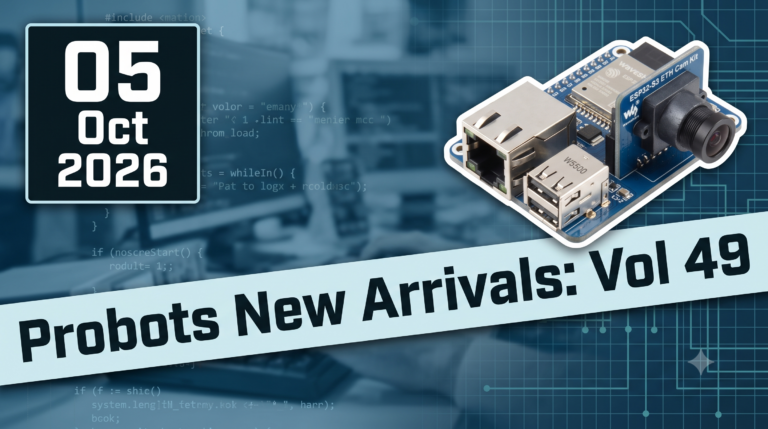 ● 13 min read
Workbench Vol. 49 🚀 The Project Trifecta: 3 Builds to Start Today We don’t just stock parts; we curate ecosystems. This week’s arrivals are desi
Read Article →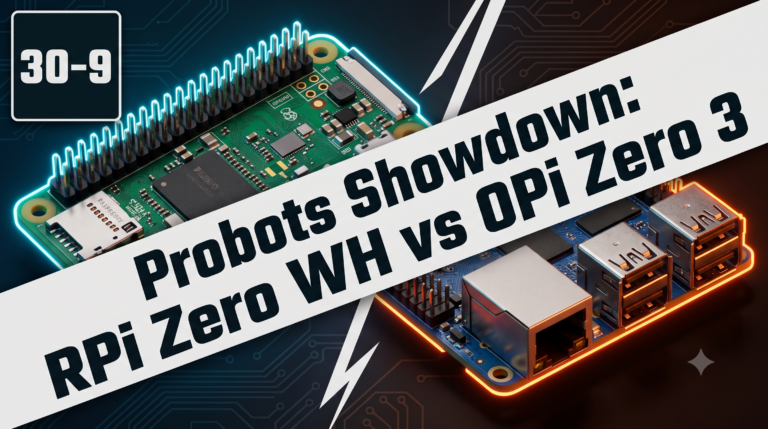 ● 18 min read
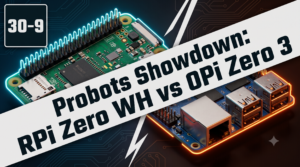
Vol. 59 | The Battle of the Bite-Sized Boards Picture a project that needs full Linux, networking, and GPIO—but has almost no room for a conventional
Read Article →