








 ● 20 min read
Showdown: RS550 12V DC 8000 vs RS-555 12V DC 6000 RPM DC Motor
Vol. 56 | The Heavyweight DC Drivetrain Duel Reliability isn’t optional when you’re designing actuators that need to move actual steel or
Read Article →
| Bulk Pricing | ||
|---|---|---|
| QTY | Unit Price(Inlc. GST) | |
| 25+ | ₹57.82 ₹ 49 + 8.82 GST | |
| 50+ | ₹57.23 ₹ 48.5 + 8.73 GST | |
| 75+ | ₹56.64 ₹ 48 + 8.64 GST | |
| 100+ | ₹55.46 ₹ 47 + 8.46 GST | |
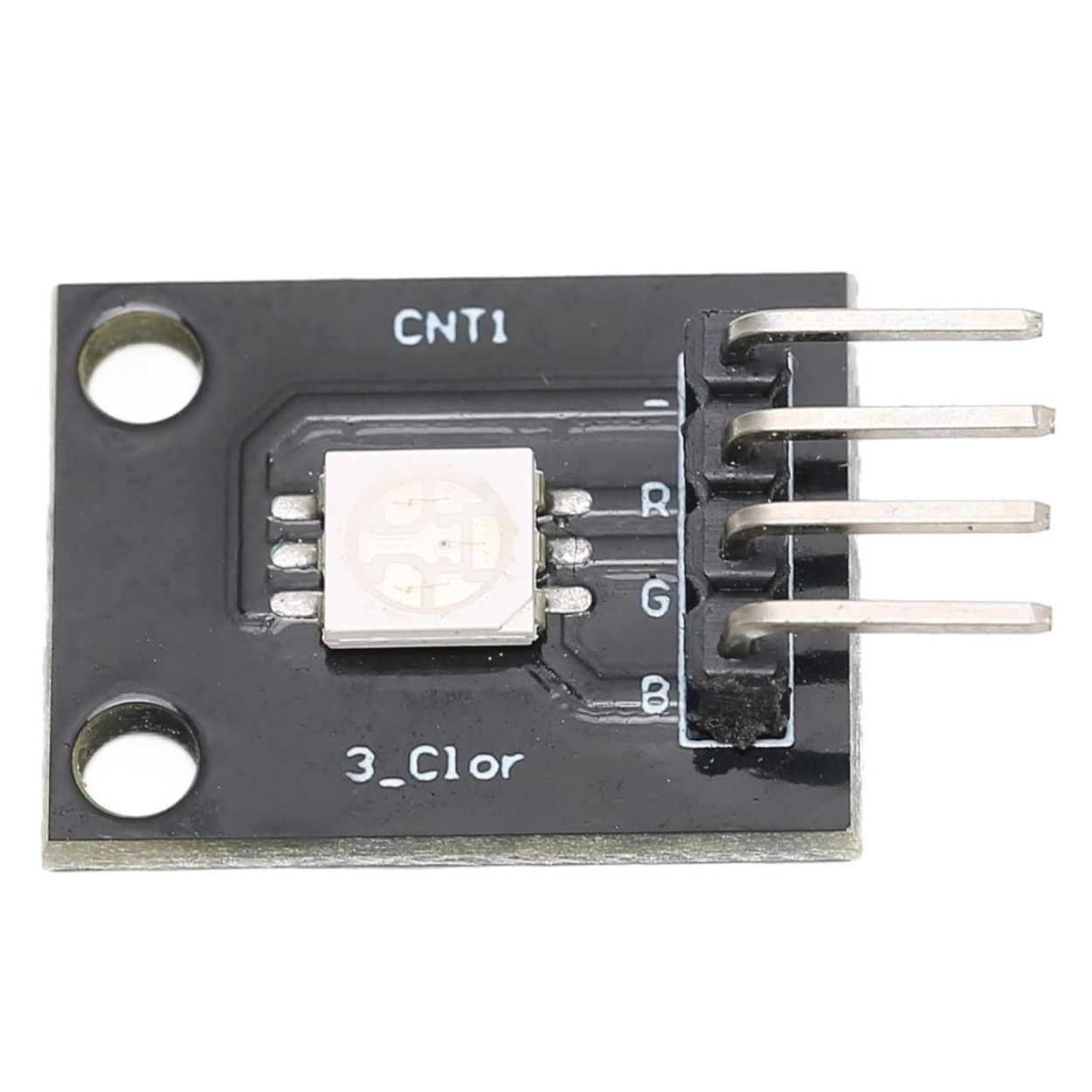
Generate infinite colors with a single module! This breakout board features a super-bright 5050 SMD RGB LED in a common cathode layout. Simply use PWM signals from your microcontroller to mix red, green, and blue light. Note: External current-limiting resistors are required.
Infinite Color Mixing via PWM This isn't just a red, green, and blue light; it is a canvas for millions of colors. The 5050 SMD package actually contains three distinct, microscopic LED crystals (one Red, one Green, one Blue) placed incredibly close together. By using Pulse Width Modulation (PWM) pins on your Arduino, you can rapidly turn each color on and off to varying degrees, effectively dimming them independently. By mixing a dimmed red, a bright green, and a medium blue, your eye blends the light together, allowing you to output deep purples, bright cyans, warm oranges, and everything in between.
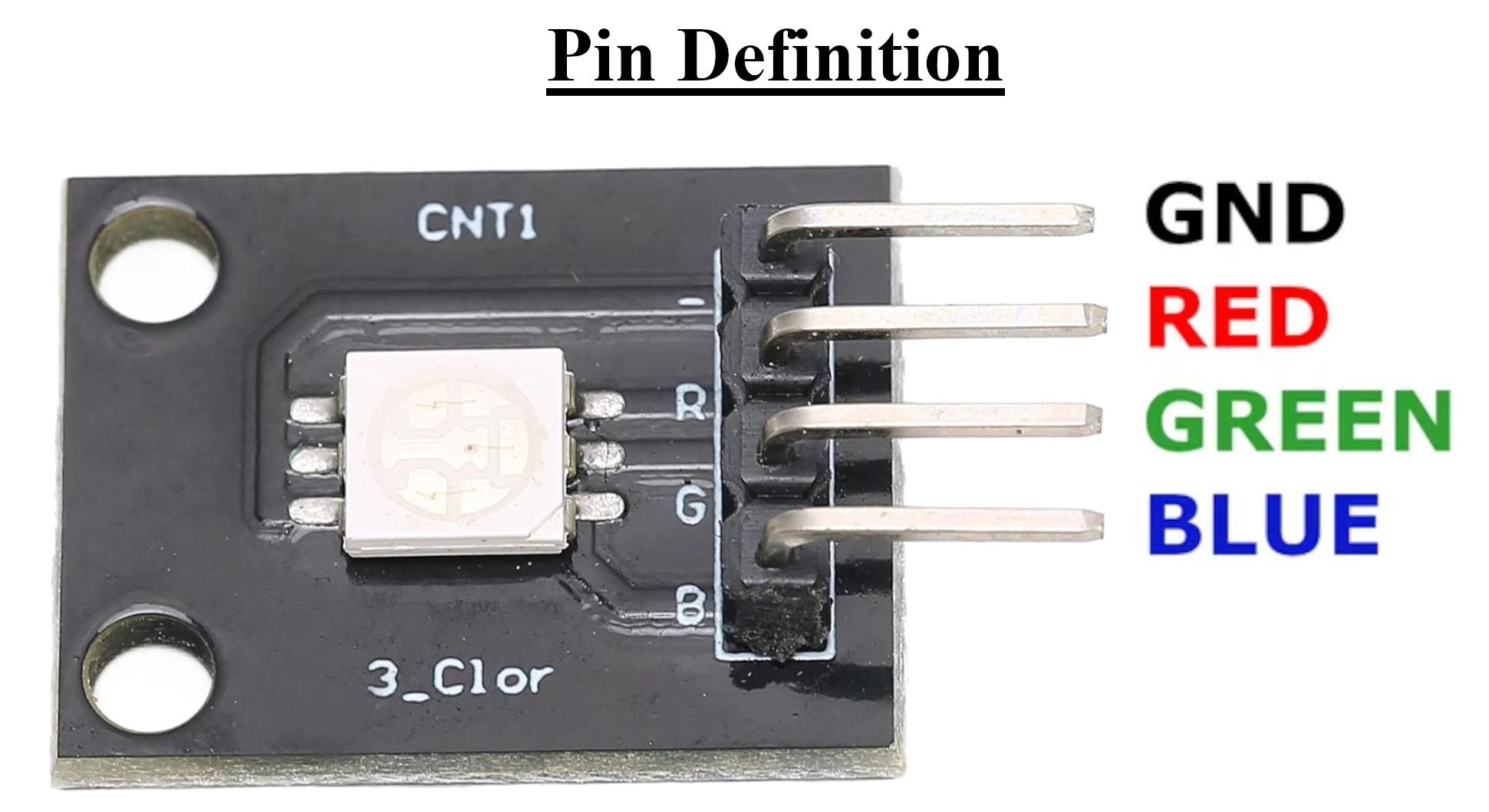
Common Cathode Simplicity Wiring RGB LEDs can sometimes be confusing, but this module uses the highly preferred "Common Cathode" configuration. This means all three internal LEDs share a single Ground line. You simply connect the pin labeled - to your system's Ground (GND). Then, you apply positive voltage signals to the R, G, and B pins to illuminate the respective colors.
⚠️ Crucial Design Note: External Resistors Required When looking closely at the bare PCB, you will notice there are no tiny black resistors soldered onto the board; the pins run straight to the LED. LEDs are "current-hungry" devices; if you connect the R, G, or B pins directly to a 5V power source without a resistor, the LED will draw too much current and instantly burn out with a pop. You must wire a current-limiting resistor (typically 220 Ohm to 330 Ohm) in series with the R, G, and B lines before connecting them to your microcontroller.
Specifications
LED Type: 5050 Surface Mount Device (SMD)
Color Channels: Red, Green, Blue
Configuration: Common Cathode (Shared Ground)
Pinout: - (GND), R (Red), G (Green), B (Blue)
Forward Voltage (Red): ~2.0V to 2.2V DC
Forward Voltage (Green/Blue): ~3.0V to 3.2V DC
Max Current: 20mA per color channel
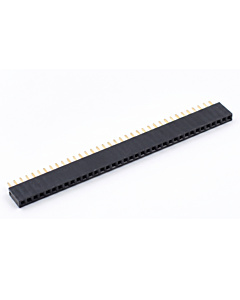
Pin Pitch: Standard 2.54mm (0.1")
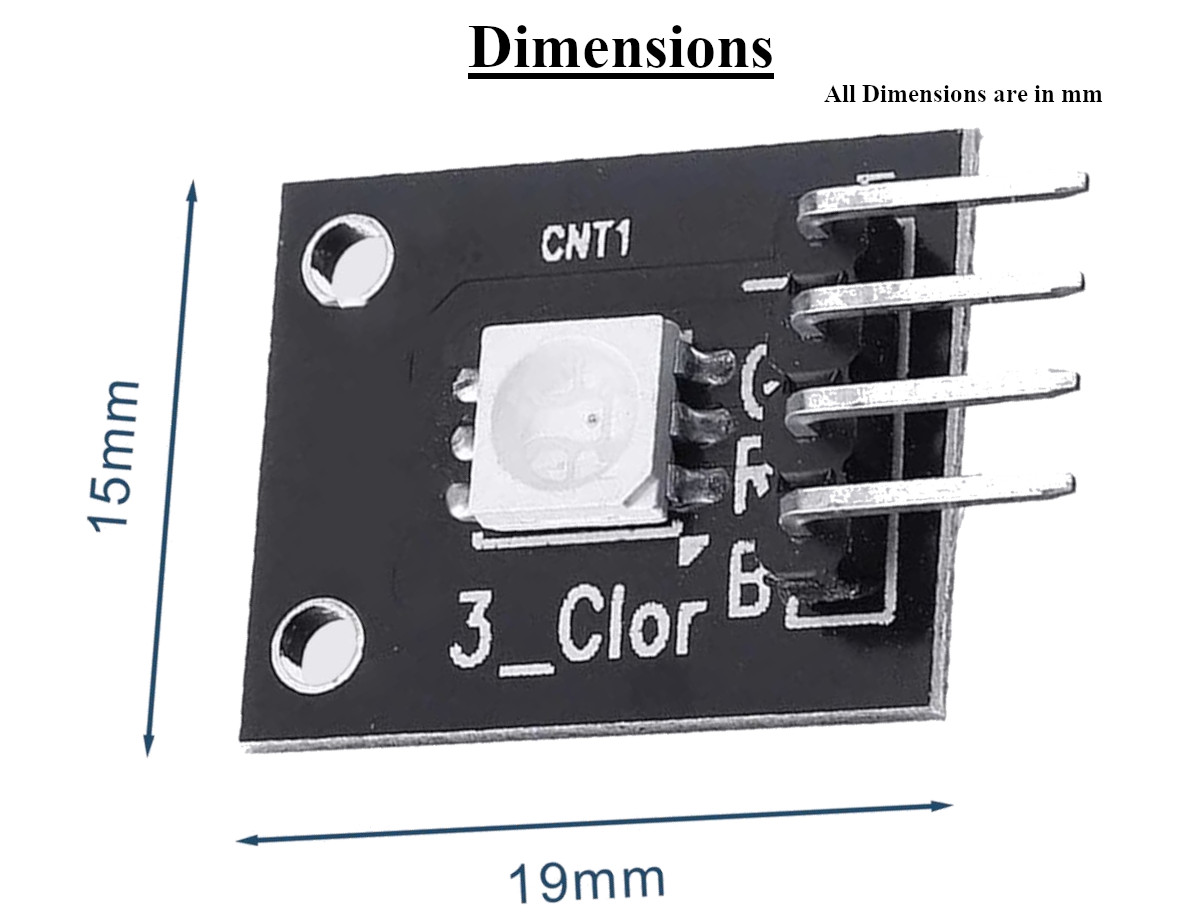
Dimensions: 19mm x 15mm
Key Applications and Projects
System Status Indicators: Programming your 3D printer or IoT sensor to glow Green for "Online", Blue for "Connecting", and Red for "Error."
Interactive Mood Lamps: Reading data from a DHT11 temperature sensor and having the LED slowly transition from icy blue to fiery red as the room warms up.
PWM Learning Platform: The absolute best hardware for visually understanding how 8-bit analogWrite() commands translate into physical hardware changes.
1 x RGB LED Module SMD 3 Colour (Common Cathode)
Q: What does "Common Cathode" mean? A: Cathode is the negative side of an LED. Common Cathode means the internal Red, Green, and Blue LEDs all share one single negative ground pin (labeled -). You turn the colors on by applying positive voltage to the individual R, G, and B pins.
Q: Do I need to use resistors with this module? A: Yes! This specific breakout board does not feature onboard current-limiting resistors. If you hook it directly to 5V, it will burn out. You should place a 220 Ohm or 330 Ohm resistor on the wire leading to the R, G, and B pins.
Q: Can I use one resistor on the Ground pin instead of three on the RGB pins? A: It is highly discouraged. Because the Red, Green, and Blue diodes all have different forward voltage drops (Red requires less voltage than Blue), using a single shared resistor on the ground line will cause the colors to draw unequal current, resulting in weird color mixing and potentially burning out the Red channel. Always use three separate resistors.
Q: How do I make the color purple? A: To make purple, you need to turn on both the Red and Blue LEDs while leaving the Green LED off. Using Arduino PWM (0-255 scale), you might use analogWrite(redPin, 150) and analogWrite(bluePin, 255).
Q: Can I make white light with this? A: Yes. By turning all three channels (Red, Green, and Blue) on to their maximum brightness simultaneously, the light will blend into a bright, slightly cool-tinted white.
Q: What does the "5050" mean? A: 5050 refers to the physical footprint of the SMD LED package. It means the plastic square housing the LED crystals measures exactly 5.0mm by 5.0mm.
Q: What do the pins CNT1 and 3_Clor on the board mean? A: Those are just generic manufacturer silkscreen labels. "3_Clor" is a typo for 3-Color, and CNT1 likely refers to Connector 1. The only labels you need to worry about are the -, R, G, and B markings.
Q: Can I plug this directly into a breadboard? A: Yes, the four male pins are spaced at the industry-standard 2.54mm (0.1 inch) pitch, making them perfectly compatible with standard breadboards and dupont jumper wires.
Q: Can I run this off a 3.3V microcontroller like a Raspberry Pi or ESP32? A: Yes, 3.3V logic is perfectly fine. You will still need small current-limiting resistors (e.g., 100 Ohm to 220 Ohm) to protect the microcontroller's GPIO pins from drawing more than their rated current limit.
Probots sells every Electronics Part for your next Project. You can order 10,000+ Electronic Parts Online - Arduino, Raspberry Pi, NodeMCU Development Boards, Sensors, Motors, Motor Drivers, SMPS, Plastic Enclosures etc in India directly on probots.co.in
We delivery electronics components and parts throughout India using standard couriers like Bluedart, Delhivery & India Post.
For order related queries contact -
This item is covered by a warranty of 7 days from the date of delivery, against confirmed manufacturing defects only, as verified by Probots' own testing and investigation. In case of a confirmed defect, we will replace the item — a refund is issued only if a replacement can't be supplied (e.g. discontinued or out of stock). Transit damage or a wrong item received must be reported within 3 days of delivery.
If the product shows signs of misuse, tampering, physical damage, static discharge, liquid or fire damage, use of unapproved chemicals, or has been soldered or physically altered in any way.
China
Probots sells every Electronics Part for your next Project. You can order 10,000+ Electronic Parts Online - Arduino, Raspberry Pi, NodeMCU Development Boards, Sensors, Motors, Motor Drivers, SMPS, Plastic Enclosures etc in India directly on probots.co.in
We offer specialized services for Bulk, Wholesale & B2B Customers like discounted prices, additional shipping options, customised products, etc . Customer with large quantity & regular orders qualify for the specialised discounted rates.
We also offer dedicated sales team to assist you with the order process by providing sales quotations, PI, technical support for choosing products, etc.
Note: Business Orders are processed manually and usually take 1-3 days to process compared to placing the order directly on our website. Please plan your purchases accordingly.
Need Help?
For bulk enquiries contact us by -
Probots Electronics is highly regarded for its highly skilled team and knowledgeable staff who provide expert guidance to ensure customers select the right components for their technical projects. The business maintains a strong reputation for prompt service and reliable support, with many clients praising their quick response times and genuine commitment to customer satisfaction.


A very great place for electronics Such a well maintained shop... Felt good shopping here


Nice

For new developments kit available and they will support till working, and I suggest this place strongly


This place has all the electronic parts students will ever need, staff is friendly and the place is organised.


It was a really nice experience! I was happy to find such a wide range of robotics kits for kids, suitable for different age groups and learning levels.

Excellent experience




Good stuff

Buyed them. But no bargain. Helpful staff.


Available all children school project spears parts like electronics


It was good experience




Staff is very patient and helpful

One of the best place for electronics you will get everything you want! With the best and orginal quality

Very helpful staff and the best place to buy components for projects

Wonderful store with expert service and technically strong people.

Prompt delivery, excellent technical support


Large inventory of electronic components and parts. Well trained service personnel and technicians who can quickly identify and rectify product defect if any. They are a reliable and trustworthy online stores.

A very great place for electronics Such a well maintained shop... Felt good shopping here
Nice
For new developments kit available and they will support till working, and I suggest this place strongly
This place has all the electronic parts students will ever need, staff is friendly and the place is organised.
It was a really nice experience! I was happy to find such a wide range of robotics kits for kids, suitable for different age groups and learning levels.
Excellent experience
Good stuff
Buyed them. But no bargain. Helpful staff.
Available all children school project spears parts like electronics
It was good experience
Staff is very patient and helpful
One of the best place for electronics you will get everything you want! With the best and orginal quality
Very helpful staff and the best place to buy components for projects
Wonderful store with expert service and technically strong people.
Prompt delivery, excellent technical support
Large inventory of electronic components and parts. Well trained service personnel and technicians who can quickly identify and rectify product defect if any. They are a reliable and trustworthy online stores.
● 20 min readVol. 56 | The Heavyweight DC Drivetrain Duel Reliability isn’t optional when you’re designing actuators that need to move actual steel or
Read Article → ● 13 min read
Workbench Vol. 49 🚀 The Project Trifecta: 3 Builds to Start Today We don’t just stock parts; we curate ecosystems. This week’s arrivals are desi
Read Article → ● 18 min read
Vol. 59 | The Battle of the Bite-Sized Boards Picture a project that needs full Linux, networking, and GPIO—but has almost no room for a conventional
Read Article →