















 ● 20 min read
Showdown: RS550 12V DC 8000 vs RS-555 12V DC 6000 RPM DC Motor
Vol. 56 | The Heavyweight DC Drivetrain Duel Reliability isn’t optional when you’re designing actuators that need to move actual steel or
Read Article →
| Bulk Pricing | ||
|---|---|---|
| QTY | Unit Price(Inlc. GST) | |
| 25+ | ₹48.02 ₹ 40.69 + 7.32 GST | |
| 50+ | ₹47.53 ₹ 40.28 + 7.25 GST | |
| 75+ | ₹47.04 ₹ 39.86 + 7.17 GST | |
| 100+ | ₹46.06 ₹ 39.03 + 7.03 GST | |
Add custom melodies and alarms to your projects with this passive buzzer module. Operating safely between 3.3V and 5V, it features a built-in transistor driver, a low-level trigger, and requires an external PWM signal to generate various musical tones.
The "Passive" Advantage There are two main types of buzzers: Active and Passive. An active buzzer has an internal oscillator; if you give it 5V, it immediately emits a fixed, loud screech. This Passive Buzzer Module has no internal oscillator. If you just give it DC power, it will remain completely silent. To make it produce sound, you must send it a square wave (PWM) signal. The buzzer will vibrate at the exact frequency of the signal you send it. This allows you to program your Arduino to play everything from the Mario theme song to distinct warning chirps and UI notification "blips."
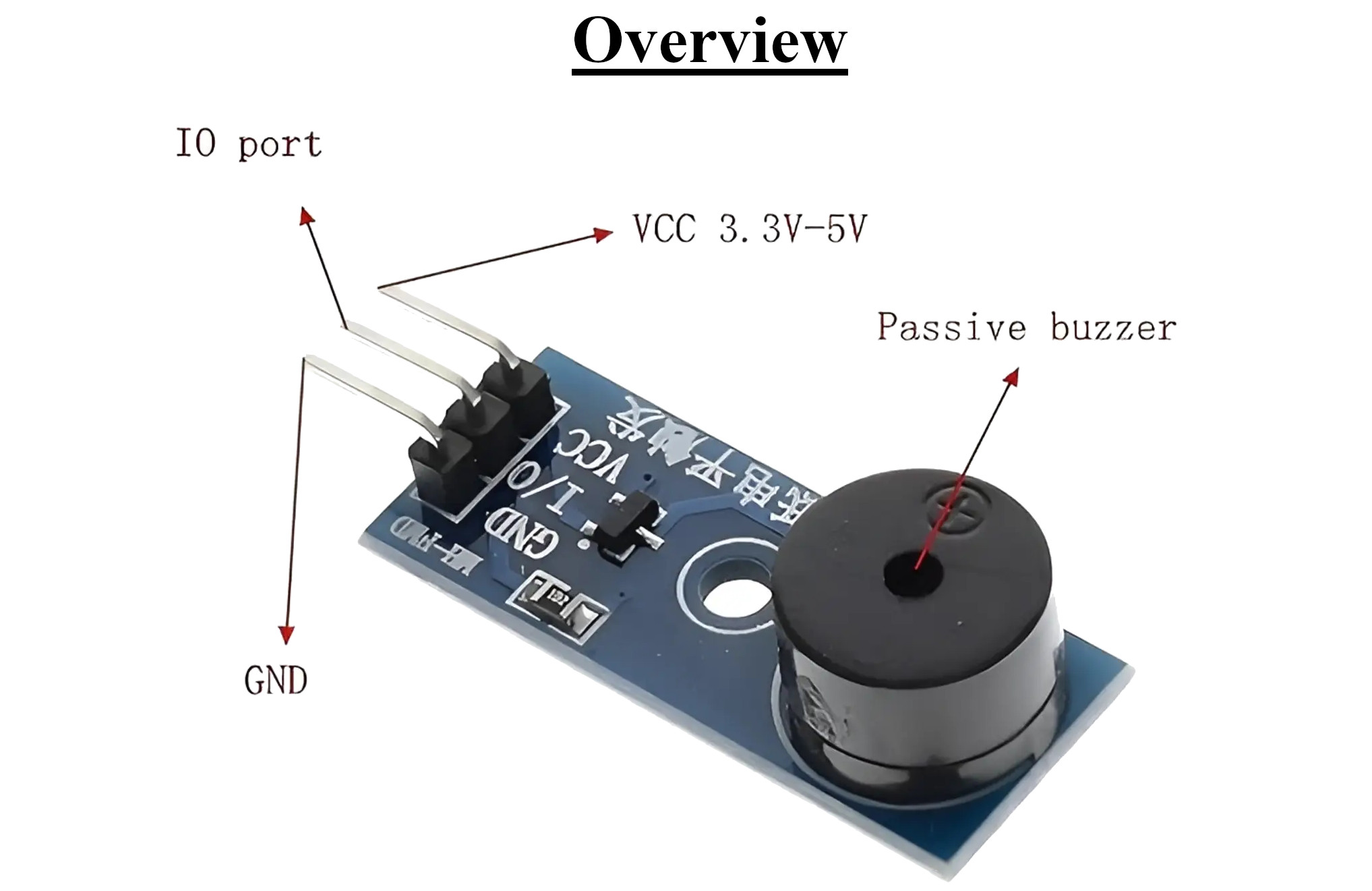
Safe, Low-Level Trigger Circuit Connecting a raw piezo buzzer directly to a microcontroller pin can sometimes draw too much current and damage the pin. This module solves that by including a built-in J3Y transistor driving circuit. This circuit handles the heavy lifting. The module is configured as a Low-Level Trigger, meaning the buzzer activates when the signal (I/O) pin is pulled to Ground (LOW), rather than when it receives voltage (HIGH).
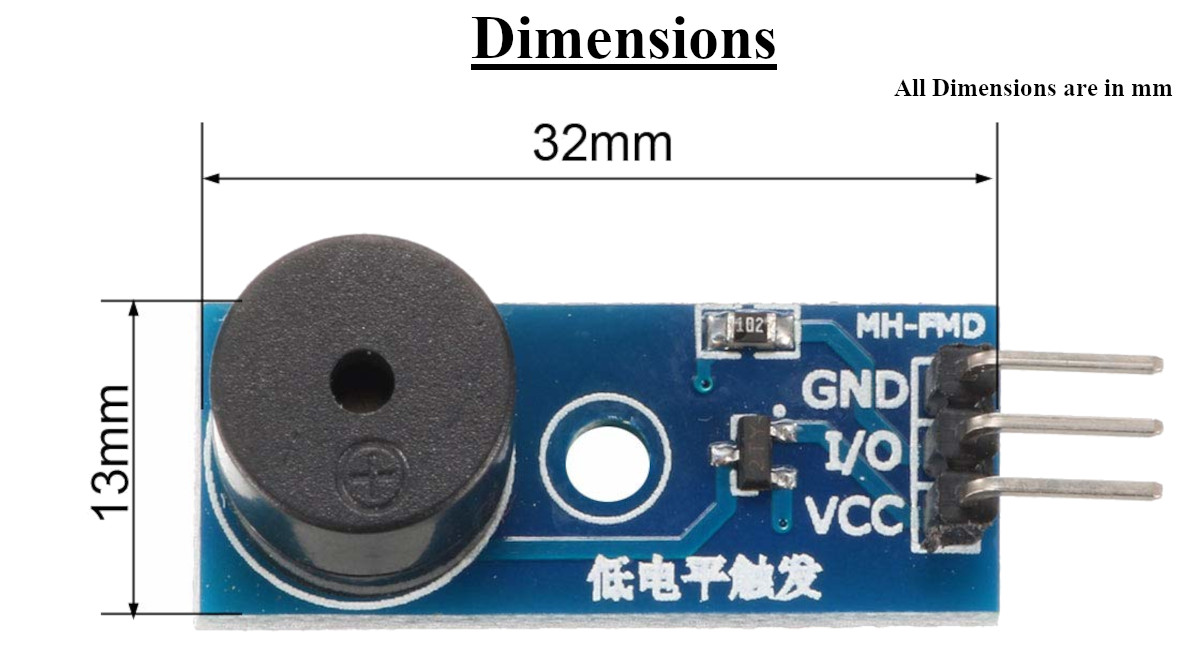
Simple 3-Pin Integration Measuring just 32mm long by 13mm wide, this tiny module fits easily into any enclosure. Wiring is incredibly straightforward. It features three standard header pins: VCC (accepts anywhere from 3.3V to 5V), GND (Ground), and I/O (your signal wire). There is also a conveniently placed central mounting hole for securing the PCB with an M2 or M3 screw.
Module Type: Passive Piezoelectric Buzzer
Operating Voltage: 3.3V to 5V DC
Trigger Type: Low-Level Trigger
Control Signal: PWM / Square Wave
Dimensions (L x W): 32mm x 13mm
Pins: VCC, I/O, GND
Mounting: 1x Central mounting hole
Custom User Interfaces: Adding distinct "success" chimes, "error" buzzes, and button-click feedback to your custom keypad projects.
Musical Gadgets: Programming an Arduino to act as a mini electronic piano, playing different notes when different buttons are pressed.
Smart Alarm Clocks: Using a Real-Time Clock (RTC) module to trigger the passive buzzer to play your favourite 8-bit melody when it's time to wake up.
Unlock New Capabilities (Project Evolution)
The Smart Pomodoro Timer: Staring at a silent screen while studying is boring. Evolve your productivity! Combine this passive buzzer with an ESP32, a rotary encoder, and a small OLED screen. Program a 25-minute study timer. When the timer hits zero, instead of a harsh, annoying beep, have the ESP32 pulse the buzzer's I/O pin with specific frequencies to play the "Level Complete" fanfare from your favorite retro video game!
1 x Passive Buzzer Module (Low-Level Trigger)
What is the difference between a passive and active buzzer? An active buzzer makes a sound as soon as it receives power (like a smoke detector). A passive buzzer requires an oscillating signal (like an audio speaker) to make sound, allowing it to play different musical notes.
What does "Low-level trigger" mean? It means the internal circuit activates the buzzer when the I/O signal pin receives a LOW signal (0 Volts / Ground) from your microcontroller.
What voltage does this module require? The VCC pin can accept any standard logic voltage between 3.3V and 5V DC.
Can I just connect power and ground to make it beep? No. Because it is passive, applying straight DC power will only result in a faint "click" sound. It requires a pulsing AC/PWM signal on the I/O pin to vibrate.
What do the three pins do? VCC provides power, GND connects to the ground of your circuit, and the I/O pin receives the frequency signal from your microcontroller.
What are the exact dimensions of the board? The PCB measures exactly 32mm long by 13mm wide.
How do I make it play different notes? You change the frequency of the PWM signal being sent to the I/O pin. A higher frequency produces a higher-pitched note.
Does this work easily with Arduino? Yes! You can use the built-in Arduino tone(pin, frequency) command to easily send the correct square waves to the buzzer.
Can I use this with a Raspberry Pi? Yes, you can use software PWM or hardware PWM pins on the Raspberry Pi to generate the required frequencies.
Will this draw too much current from my Arduino pin? No. The module features a built-in SMD transistor (the tiny black chip marked J3Y or similar), which safely draws the operating current directly from the VCC pin, not your delicate signal pin.
Can this play MP3 audio or voice recordings? No. A piezo buzzer can only generate simple tones and beeps (square waves). It cannot reproduce complex analog audio waveforms like human speech.
What happens if I send a HIGH signal to the I/O pin? Because this is a low-level trigger module, sending a steady HIGH signal will keep the buzzer turned off and completely silent.
Why is my buzzer just making a quiet clicking sound? You are likely sending it a steady HIGH or LOW signal. You must rapidly pulse the signal pin (HIGH, LOW, HIGH, LOW) hundreds of times a second to create a sound wave.
How loud is the buzzer? It is relatively loud (typically around 80 to 85 decibels at close range), which is perfect for desktop alarms and user interface feedback.
Is there a way to securely mount it? Yes, there is a circular hole right in the middle of the blue PCB for securing it with a small machine screw.
Can I use it with a 3.3V ESP32 or ESP8266? Yes, the module supports 3.3V operation, making it perfectly safe and compatible with 3.3V microcontrollers.
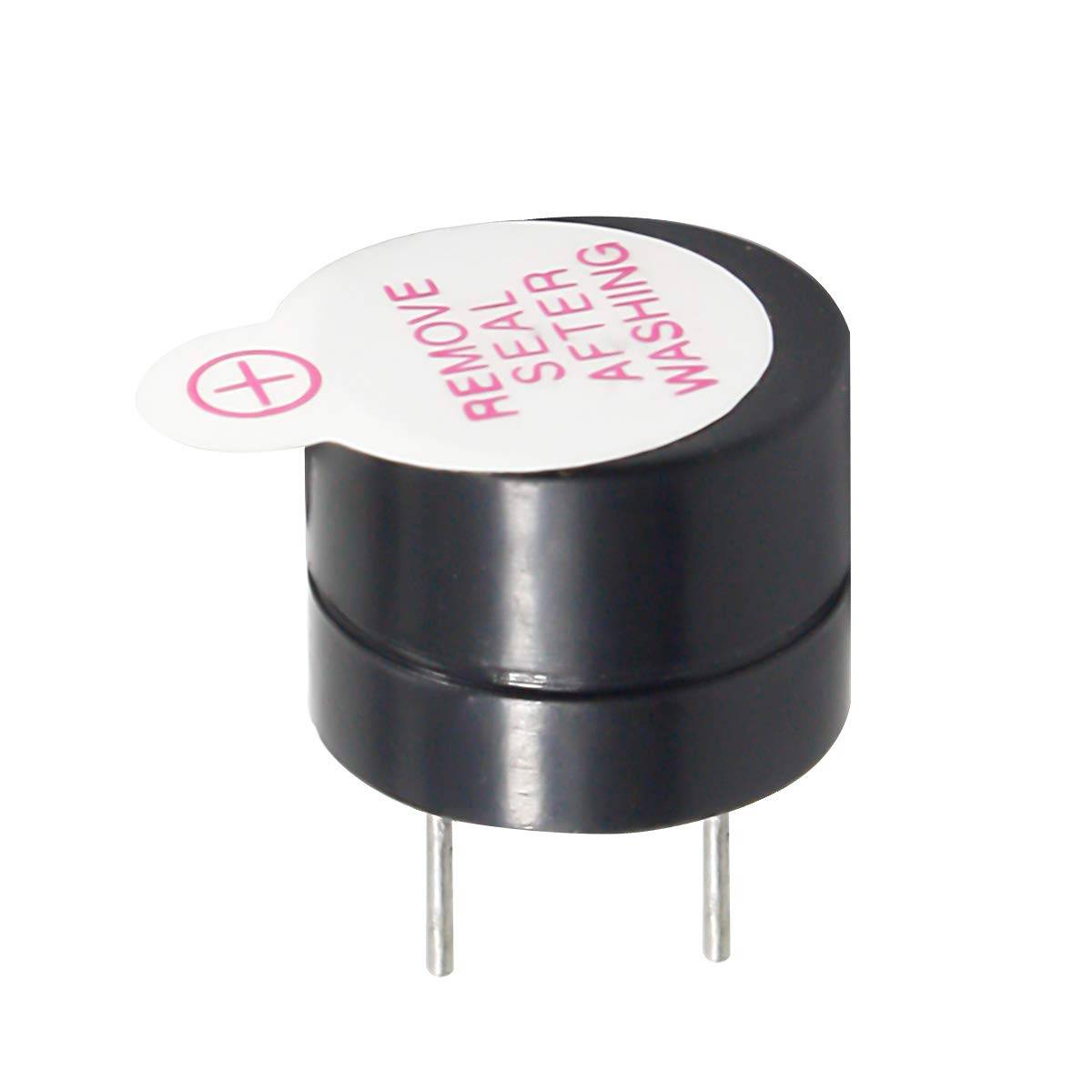
What is the large black cylinder? That is the plastic resonant housing that covers the delicate piezoelectric ceramic disc inside.
Do I need to add a resistor in series with the signal pin? No, the breakout board already includes the necessary resistors for the transistor driving circuit.
What does the small "+" symbol on the black cylinder mean? It indicates the polarity of the raw buzzer component beneath the sticker, though you do not need to worry about it, as the PCB routes all the wiring correctly for you.
Is the module waterproof? No, the hole in the top of the buzzer will easily allow water inside, which will short out the piezoelectric element. It is for indoor/dry use only.
| Buzzer Output Type | Passive |
|---|---|
| Output Type | Intermittent |
| Length (mm): | NA |
Probots sells every Electronics Part for your next Project. You can order 10,000+ Electronic Parts Online - Arduino, Raspberry Pi, NodeMCU Development Boards, Sensors, Motors, Motor Drivers, SMPS, Plastic Enclosures etc in India directly on probots.co.in
We delivery electronics components and parts throughout India using standard couriers like Bluedart, Delhivery & India Post.
For order related queries contact -
This item is covered by a warranty of 7 days from the date of delivery, against confirmed manufacturing defects only, as verified by Probots' own testing and investigation. In case of a confirmed defect, we will replace the item — a refund is issued only if a replacement can't be supplied (e.g. discontinued or out of stock). Transit damage or a wrong item received must be reported within 3 days of delivery.
If the product shows signs of misuse, tampering, physical damage, static discharge, liquid or fire damage, use of unapproved chemicals, or has been soldered or physically altered in any way.
China
Probots sells every Electronics Part for your next Project. You can order 10,000+ Electronic Parts Online - Arduino, Raspberry Pi, NodeMCU Development Boards, Sensors, Motors, Motor Drivers, SMPS, Plastic Enclosures etc in India directly on probots.co.in
We offer specialized services for Bulk, Wholesale & B2B Customers like discounted prices, additional shipping options, customised products, etc . Customer with large quantity & regular orders qualify for the specialised discounted rates.
We also offer dedicated sales team to assist you with the order process by providing sales quotations, PI, technical support for choosing products, etc.
Note: Business Orders are processed manually and usually take 1-3 days to process compared to placing the order directly on our website. Please plan your purchases accordingly.
Need Help?
For bulk enquiries contact us by -


Probots Electronics is highly regarded for its highly skilled team and knowledgeable staff who provide expert guidance to ensure customers select the right components for their technical projects. The business maintains a strong reputation for prompt service and reliable support, with many clients praising their quick response times and genuine commitment to customer satisfaction.


A very great place for electronics Such a well maintained shop... Felt good shopping here


Nice

For new developments kit available and they will support till working, and I suggest this place strongly


This place has all the electronic parts students will ever need, staff is friendly and the place is organised.


It was a really nice experience! I was happy to find such a wide range of robotics kits for kids, suitable for different age groups and learning levels.

Excellent experience




Good stuff

Buyed them. But no bargain. Helpful staff.


Available all children school project spears parts like electronics


It was good experience




Staff is very patient and helpful

One of the best place for electronics you will get everything you want! With the best and orginal quality

Very helpful staff and the best place to buy components for projects

Wonderful store with expert service and technically strong people.

Prompt delivery, excellent technical support


Large inventory of electronic components and parts. Well trained service personnel and technicians who can quickly identify and rectify product defect if any. They are a reliable and trustworthy online stores.

A very great place for electronics Such a well maintained shop... Felt good shopping here
Nice
For new developments kit available and they will support till working, and I suggest this place strongly
This place has all the electronic parts students will ever need, staff is friendly and the place is organised.
It was a really nice experience! I was happy to find such a wide range of robotics kits for kids, suitable for different age groups and learning levels.
Excellent experience
Good stuff
Buyed them. But no bargain. Helpful staff.
Available all children school project spears parts like electronics
It was good experience
Staff is very patient and helpful
One of the best place for electronics you will get everything you want! With the best and orginal quality
Very helpful staff and the best place to buy components for projects
Wonderful store with expert service and technically strong people.
Prompt delivery, excellent technical support
Large inventory of electronic components and parts. Well trained service personnel and technicians who can quickly identify and rectify product defect if any. They are a reliable and trustworthy online stores.
● 20 min readVol. 56 | The Heavyweight DC Drivetrain Duel Reliability isn’t optional when you’re designing actuators that need to move actual steel or
Read Article → ● 13 min read
Workbench Vol. 49 🚀 The Project Trifecta: 3 Builds to Start Today We don’t just stock parts; we curate ecosystems. This week’s arrivals are desi
Read Article → ● 18 min read
Vol. 59 | The Battle of the Bite-Sized Boards Picture a project that needs full Linux, networking, and GPIO—but has almost no room for a conventional
Read Article →